Our office has come into possession of a bunch of old issues of The Architectural Forum magazine and I have been going back and reading through them with great pleasure. This magazine was first published in 1892 under the title of ‘The Brickbuilder’ and was last published in 1974, widely considered to be the best publication on architecture during it’s run. I found an article in the New York Times from March 1, 1967 that said Architectural Forum was bought by Henry Luce, the creator if the Time-Life magazine empire, in 1932 when it was still considered a trade magazine. The magazine was sold and bought and resold several times over until it’s last issue was published March of 1974.
One of the issues I have been going through had an article where it was comparing and contrasting two “competent and parallel examples of traditional and modern architecture“. One a traditionally designed home by the firm Derby, Barnes and Champney Architects in Sudbury, Mass. and the other a modern home by the firm of Gropius and Breuer, Architects.
This magazine has captured my attention because it appears to be written for two distinct audiences – the architecturally educated, and the architectural enthusiast. Several of the comments and items that are explored in this article are not resolved but rather presented in such a way as to propel the train of thought in a particular direction with the purpose of creating a dialog between the author and the reader. Not too much different than today’s blog environment but without the immediacy and instant reciprocation of point and counterpoint.
“..such material should prove provocative and, it is hoped, instructive.” – The Editors
The article that I selected to put in here today is trying to introduce the topic of transition in the styles of work between to well known firms. The concepts are attempting to deal with the logical vs. the emotional, inside vs. outside, and appropriateness of material vs location, etc.
These are relevant topics 70 years later (as evidence by my recent post asking the question if a modern house can be a good neighbor).
I can’t tell you how humorous I find it that the traditional house has a “Shed” where you park the cars and the modern plan labels it for what it is – a garage. This article would not be nearly as interesting if the plans had not been included for comparison. Think it is of any importance that the modern plan denotes North on the plans? You’d better believe it. If you are going to show an example of a traditional house with it’s interior turned in on itself and compare it to a modern house that’s closed on one side and with large expanses of glass on the other, which way is North is going to figure into the conversation – even back then.
.
“Does a view of the sea improve the quality of the roast? Or do cooks prefer flowers? Is this the warmth of home versus the operating room?”
.
.
These issues have been an blast to go through and it’s killing me that I can’t discuss the specifics of some of the articles over a few beers. The very least I can do I will – which means I am going to pull some of these articles out and share them with you. If you haven’t ever seen an issue of The Architectural Forum, please try and get your hands one some. It is amazing how current these 70 year old issues seem and how on topic the concerns of 1939 compare with those of 2010. As the saying goes, the more things change, the more they stay the same.
So I wasn’t planning on writing another post on my house for a while but we had a bit of excitement on Saturday night. Around 11:15pm we get a loud knock on the door - and since we aren’t in the habit of receiving late night visitors, I was slightly concerned. As it turns out, it was some kindly folks who had stopped by to let me know that my yard was erupting and that I was flooding the neighborhood. It wasn’t of biblical proportions but when you see enough water coming out over every crack and crevice of your pavement, it gets your attention.

That is a lot of water
Well shit dang. There is no circumstance where water shooting from the ground in hundreds of mini volcanoes is a good thing. While I will concede that for a few moments I was excited that I wouldn’t have to water my lawn for a few days, the reality of the situation settled in and the more obvious issues were:
- where was the water coming from? and
- was it my fault? (I had asked God to smite someone earlier for driving like an idiot, an obvious waste of his time and resources - maybe this was a reminder that he who doth asketh foreth the smite, dothest receiveth the smite)

Water sheet flowing out of my driveway
First thing I did was go to my water meter to see if it was actually my leak. Once the initial shock went away, I wasn’t overly concerned because I know that my domestic water lines run down the alley and this was way too much water to be a sprinkler line issue. This is also one of those times when I know my wife is glad that I know stuff and that I’m not just eye candy. My meter wasn’t moving so I knew this was a city problem, and that a water line feeding the network of fire hydrants was the most likely culprit.

One of 50 mini eruptions
The city had work vehicles on site in about 10 minutes – which is remarkably fast. I think the workers were a little amused by me running around taking pictures once they figured out they weren’t for insurance purposes and I wasn’t out for blood. They were nice guys who were more concerned about making sure I felt taken care of than looking like they were trying to do something. I knew that actually turning the water off would take a little time so I wasn’t busting their chops about the rate at which my yard was being washed away. Luckily I live in a place where I know they will take care of things properly. I had been in bed (but not asleep) by the time they got the water turned off, sometime before 2:00am.

cleaning up the mud and washout
When I got up at 6:15, they had started the process of cleaning up all the washed out dirt. The sounds of shovels scraping pavement, while not pleasant, was welcome enough – at least I knew they were seeing things through before they passed the scope of replacing the 12″ water line to the full time day crews that will start what I am told will be a very big project. Depending on the scope, I might try and implement some of the driveway considerations I am trying to work through (you can see the drawings here). Not sure yet how much curb they will be pulling out (might not be any) but I can hope!
If I could turn this into a teaching opportunity it would be this:
- Locate your water meter
- Make sure you have a key to remove the lid (these can be purchased at most major home improvement stores)
- Learn how to shut the water off to your property.
Turns out I didn’t need to make use of any of the things I know but just knowing how to check the meter and shut the water off made the situation a lot less frantic. Since they were able to isolate the line and shut that portion down, nobody lost access to their domestic water. If you every do learn that you are about to lose water for a while, make sure you fill up a tub so you have the ability to put water in the tank of your toilet so that you can flush it after using it.
Cheers.
.
I have been working on selecting plumbing vessels and faucet sets on one of our projects here at the office and seeing all the really great stuff that is out there just makes me salivate for the time when I can address the needs of my own bathroom. I don’t anticipate any work beginning in the near future but I thought it would be interesting to take a look at the current layout, situation and issues that lie before me. I would state for the record that my wife and I have differing opinions about our bathroom; she is for blowing things up and starting over and I would rather work with what I have and just clean it up.
.
So this is the plan – hopefully everyone here can read plans so I am just going to fast forward a little and get to the narrative. We have a playroom for a shower – even by today’s standards, this 8′ x 8′ shower room is large. But that is only one of the issues (not that large is bad but it isn’t necessarily good either). Some of the highlighted issues are:
- The ‘bathtub’ isn’t really a bathtub – it’s a glorified depression into the slab. The one positive I will say about this ‘feature’ is that it lowers you down which ends up providing you some visual protection from the outside.
- There was a leak of something in the past and the bottom 12″ or so of the wet wall were demolished and then replaced with an unfortunate tile selection. When we bought the house, there was a 1/4″ – 1/2″ gap along the wall where I can only assume water was going to die (but most assuredly trying hard to take out a bunch wood with it along the way). At least I was able to use some clear silicon and take care of that issue so future water damage averted but we have to look at it.
- There is a lot of wood in the shower which surprisingly looks great (at least by great I mean ‘undamaged’).
- There are/ were pendant light fixtures hanging down INTO THE SHOWER!! If that doesn’t make you raise an eyebrow, you must have liked your time working in the Russian Gulag. I pulled 2 of the three fixtures out and installed some vapor lights. The one I haven’t change yet is a heat lamp that despite the obvious safety hazard, I don’t want to freeze. The pendant light you can see located in the toilet room is one of the relocated fixtures from the shower. The glass housing was broken on the one in the bathroom and one of the two in the shower and having a bare light bulb hanging down in your shower is just wrong (you heard that here first). When I took them out of the shower, I replaced the one in the bathroom.

view from the main shower entry into the courtyard
- It gets cold because the shower is on two exterior walls, one of which is a large sliding glass door, which leads us to,
- There is a large sliding glass door in the shower! Maybe when you are young and stupid you don’t mind standing naked in a room with your stuff on display to any stranger brave enough to look but when your my age, it takes some getting used to.

In case you have to go during the shower
- There are 3 sets of sliding doors in the shower (that’s right – 3); One from the bathroom, one from the outdoor patio, and one from the toilet room. Mmmmm, direct access from the toilet to the shower. I can think of all kinds of reasons why that is super convenient but since I don’t live in a 3rd world country, most of them don’t apply. Something else that always struck me as funny is that the all the glass sliding doors from inside the house have privacy glass whereas the doors to the outside of the house are clear. Yeah, that totally makes sense because strangers don’t judge the size of your ass like the people who love you.

The courtyard outside the shower - thinking about installing some stadium seating and selling tickets
.
So those are all the obvious issues that need to be addressed in some form but despite them, or maybe it’s because of them, I still like the space – just not that much as a shower and don’t want to blow it up and start over. Whenever I have let my architect friends come over and tour the house, as soon as they see the shower their first reaction is “I’m down to party”. Gross. That alone will force my hand into taking action, (just not the party kind of action).
(if you are interested in the first two installments, you can find Part I here and Part II here)
.
I have been toying with the idea of creating a post that just sits there for a while and whenever I find something that stops me down and gets me to say ‘cool’, I’d stick it in that post. So this is the first one, chock-o-block full of stuff I think is kinda worth checking out. If you have something that you’ve come across, feel free to send me the links and I’ll check them out. It would be nice to figure out who some of the readers are that read Life of an Architect, even if they do want to stay in the background. You can send me your nominations and links:
bob (at) lifeofanarchitect (dot) com
I promise I won’t embarrass anyone.
Fitzgerald Formliners
Based in Santa Clara, California, for over 25 years Fitzgerald Formliners has been developing and producing some of the most technically advanced liners for concrete form work. One of the things that I like best about their pattern catalog is that they have a great selection of liners that suit the modern residential market. Some of my favorites are forms 16938 – 1.5″ Wide Plank (random lengths), 16020 – Rough Sawn Plank, and 16920 – Random Wood.
.
BOCCI
Located in Vancouver, Canada, Bocci is a contemporary design and manufacturing house. My favorite item that they have is the bocci 22 line - a complete suite of CSA – and UL approved interior wall accessories that challenge the ubiquitous cover-plate concept. A minimal alternative, 22 is designed to “mud in” directly into drywall, millwork, or any wall surface, without a visible cover plate or trim. Despite being expensive, these outlets can turn a liability into an asset and that alone can justify the cost over your more traditional outlet set-up.
.
Soli USA
Based in Los Angeles, California and founded in 1997, Soli Architectural Surfaces provides amazing tile products. Their product catalog has a mixture of old-world craftsmanship and new-world technology most all of which can be custom tailored for color, size, finish and thickness. In addition to tiles, they provide other architectural decorative surface finishes in creative and trend setting patterns, geometric shapes and varied materials such as glass, resin, basalt, sodalite and concrete. Visit their website and look for yourself.
.
Focal Point Lights
I really love it when utility light fixtures are considered and featured in the spaces they illuminate – and Focal Point Lights has lots of really clean, straightforward fixtures. Based out of Chicago, family owned and operated, I think they deliver a fantastic product at a great cost. I am particularly enamored with their collection of linear light fixtures. Utilitarian and beautiful.
.
Nikon D90
If you read Life of an Architect very often, you know that I just bought a new camera and what I went with was the Nikon D90. I did a ridiculous amount of research and read umpteen billion product and users reviews before settling on the D90. It seems to straddle the line between your straightforward point and shoot camera and one that a professional might choose to make a living. So far I am loving this camera. I take pictures of buildings -wide vista shots and close-up details – while at the same time, I use this camera for functions at my daughters school. If you are looking for a camera that is as easy to use and a point and shoot, but one that has the ability to give you some creative control (if you want), this is the camera for you.
.
DuQuella Tile
Based in Portland, Oregon, Cyra DuQuella crafts decorative ceramic art tiles using old world methods of tubelining and cuerda seca. All of their art tiles are hand-crafted and they specialize in Arts & Crafts, Bungalow, Art Nouveau and Art Deco tile. Creating tile like this is a lost art and is technically very demanding and it is very cool stuff.
.
EZY-Jamb Trimless Door Frame
Manufactured by Studco Building Systems US, LLC, EZY-Jamb is a fully adjustable split type jamb with perforated sides that allows the jamb to be set and finished with wall compound resulting in a clean modern look. We just specified this system for a weekend house and I am anxious to see how it turns out. We typically have other ways of achieving this look where the success depends more on the skill of the contractor then the proper installation of a clever product. Studco has a whole line of complimentary products to go along with the jamb system – they include EZY-Cap and EZY-Reveal.
.
Element Lighting
Element Lighting, a brand of Tech Lighting, is a line of of fully adjustable (tilt, pan rotation and lens rotation lock) and fully recessed fixtures with frame-less housing. This means that you can forgo the goof-ring of typical fixtures and when you are design modern projects, this is a very good thing. These fixtures are really slick and they come with a full compliment of sizes, shapes, baffles and colors. Definitely cool.
.

The Louvre Entry by I.M. Pei at late afternoon
Everyone needs to leave their bubble every now and again – go one town over or fly across the world to famous cities full of cigarette smokers super models and un-affordable fantastic architecture. I recently did the latter (*air punch*) and if you haven’t read the last few posts you’re lucky missing out on the type of garbage insight that only I can bring. I thought it might be interesting to lay out some of the observations I found while traveling; some are awesome, and some are terrible even more awesome. Okay, I promise I’m going to stop with the strike-through no I’m not.

Orange on orange with African tote purse and leather sandals = French Hippie!!
- Little French girls all wear dresses and their mothers do not.

red on red with ciggie, bath shoes, and cellphone
- Capri pants are very popular with the man in Paris
- Young French people all sound polite and adorable, even if they are cussing you out and insulting your choice of shoe wear.
- French people are not rude, at least not to me. I had a great experience with every French person I spoke with. Seriously, if you are from the Southwest (and I am going to call Texas the southwest) people are crazy, ridiculously friendly. Everybody here says ‘Yes Sir’ and ‘Yes Ma’am’, so by comparison, everybody else tends to appear rude. Everyone I spoke with might not have gone out of their way to be friendly like us Texans, but nobody was rude.
- French women don’t really wear bra’s – at least not the ones that should.
- Turned up collars apparently are coming back in style. I know you’re thinking ‘when did they ever go out of style?’. I know, that’s what I thought!
- Almost all French people are thin. Everyone is thin in Paris, despite eating carbohydrates like we breathe air, because everyone smokes like a chimney. Seriously thought I was going to see little kids smoking by the time I left - I spent a lot of time explaining smoking to my daughter:
.
No funny story, just a good life lesson; but I will say this – if you ever meet me and I see you litter, I’m going to punch you right in the face. I just don’t understand littering. In the gutter beside every curb in France is 50 billion cigarette butts and it makes my blood boil to see someone just pitch that butt into the street when they are done. That same person probably wouldn’t throw a drink cup into the street but for some reason, smokers think cigarette butts don’t count as trash and throwing it into the street somehow isn’t littering. You have been warned…(do you think used cigarette butts could be fashioned together to provide relief housing? Just a thought).
Finally, I wanted to include a picture of the ‘Fire Evacuation Map’ that was in my hotel. I thought it was awesome – enough to take a picture so I have included it here for your amusement. Take a good look at the people indicated in the diagram. There’s women in stilettos and wide brimmed hats, barrel chested (and one would assume good looking) men, – is that guy in green military and is he escorting people? Awesome. The guy on the middle right looks like he is practicing his karate on stairs – Wax on! But the absolute best is the last picture on the bottom right – you got the fashionista, barrel chested guy, and I’m going to say the next one is a middle aged lady and probably a cougar.
Greatest evacuation map ever.

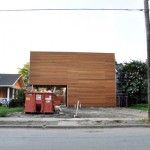
There is a new project by my office and as I have been watching it go up, it has made me think about architects + modern houses and if together they have any responsibility to the neighborhood where they get built.
This project is by award winning local architect Russell Buchanan, who started his firm in 1992 after stints working for HKS and Cunningham Architects. There are a few disclaimers I should get out of the way; I don’t really know Russell, we have met a few times but we have never engaged in a manner where I think he would remember me (although you can’t live in Dallas and not know of me, Yeah!*Air Punch*). I respect his work and I am a fan – usually. I have been through several of his projects and you can’t help but notice and appreciate his meticulous detailing. It is also fair to say that there are aspects of his work that I try to emulate in my own. The plans are extremely well resolved and he typically designs on a building material module (16″, 32″ 48″, etc.), which trust me, isn’t as easy as it sounds. Because of all these things, I am going to give him the benefit of the doubt at this stage because it’s not complete and I don’t know what’s coming (if anything – this would include possible skins/ screens and landscaping). What I am interested in discussing now is if this house, or architects in general, have a responsibility to the surrounding environment where our projects are located?

Context with Neighbor
This house site on a lot that is 50′ x 247′ within the city of Highland Park. This is a very expensive neighborhood and this particular lot was appraised by the city in 2010 at $617,500 (that’s just for the lot. Click here for Google maps link for additional adjacent context – in the aerial view, the lot shows up scrapped but in the street view, there is a green colored house still shown on the lot). By comparison, the house shown in the above picture just to the left has an appraised value $695,690 ($78,190 for the house and $617,500 for the lot). That neighbor has owned his house since 2001 when the overall appraised value was set at $358,410. It is not uncommon here that as land values go up, the value of the house goes down to keep the overall value within a state law that limits raising the property taxes more than 10% a year.
When you look at this modern style house, what comes to mind? Are you thinking as a designer and critically evaluating it? I know that’s hard to do since I haven’t given you any information other than a front elevation. Just based on that, it looks like a realized form of a parti-diagram or initial concept/ massing model that got built. What you can see and evaluate is it’s scale, the materials it uses, the relationship between public and private, and its perceived scale to the neighborhood. I should point out that the lots on this street have alley access for vehicles – so the owners never have to walk out the front door except to get the newspaper. Right now there are some supports under the “open space” in the bottom left corner of the front mass – those will go away because as I understand it from seeing the construction, that piece is cantilevered out which is part of the reason I am not passing judgement yet. What’s going to happen there?

Street Elevation
Okay – now think about those same items but put yourself in the shoes of the guy who owns the property to the left. How do you think he feels? Is this good for him and his property value? Should you care about that guy? What if he was counting on retiring on the balance between the appraised value in 2001 and 2010 of $337,280 he had hoped to get from the future sale of his home? We know from the appraisal district that his land is worth almost 8x what his house is valued at – is the inevitable irrelevancy and eminent demolition of his home all but assured now? Is it our job as architects to care about that guy? Would this be a different conversation if this modern project was sitting on a piece of land that allowed the house to be as intrinsic as it clearly wants to be? Is this about providing lodging or is it art – can it be both? Personally, I don’t believe that a building can be art – artistic yes, but not art. Art doesn’t have programming and it doesn’t have a required task to accomplish. If these houses could talk, what would they say to one another (hmmmm, another post maybe?) Are these next door neighbors going to get along when everything is completed?
My guess is no. What do you think?
I have post on another boxy house – Marlon Blackwell’s own residence that I went and saw during my visit to Arkansas. You can see that it is modern and boxy in a manner similar to Russell’s; but I had a specific conversation with Marlon (a courtesy that in all fairness I have not extended to Russell) about the context of his house in relationship to his neighbors. Part of our discussion included some of the steps he took in consideration of his neighbors, some of which included:
- Cladding the forms in wood. In person you can see that the scale of the pieces that make up the screen in front help break the scale down from the overall mass.
- Offset the second level mass over the entryway. Not only did it provide some protection from the weather, it also helped break down the overall scale of the form.
- A site benefit was that there is negative typography to this site where the creek bed flows through the lot.
- And in an effort to make nice, they opened their home up during construction to everyone at all times. Understanding a thing goes a long way in appreciating it.
There are other items that differ between these projects – most notably are the windows. These break down the box forms to human scale and allow the massing to be read as a collection of parts that contribute to a whole. I’m not against boxy residential project by any means, I even said that I would like to live in Marlon’s house (once he moved out of course), but the Russell’s project seems to be more about the message art as building and less about the building as art. In either case, the message the house is sending seems to be f**k you.
The Galeries de Paléontologie et d’Anatomie Comparée (Gallery of Paleontology and Comparitive Anatomy) is a jewel. Part of the French Muséum national d’histoire naturelle (Natural Musuem of Natural History), it is located within the Jardin des Plantes in Paris near the metro stop for Gare d’Austerlitz.
The gallery, designed by French architect Frederic Dutert, was inaugurated in 1898 as part of the l’Expositions universelles de Paris of 1900 and was the creation of Professor of Paleontology Albert Guadry and Professor of Comparative Anatomy Georges Pouchet who wished to preserve and present to the public collections from the great expeditions of traveller-naturalists of the 18th and 19th centuries.

Entrance - Galeries de Paleontologie et d'Anatomie Comparée
The sculpture at the entryway sets the tone right at the beginning – I don’t recall who did it but I thought it was awesomely awesome as a crazed monkey killing a guy could ever hope to be. Truth is, the sculpture is tame compared to some of the enjoyably odd things inside this museum. When we first decided to come here, this was purely us throwing a bone (zing!) to our daughter because she loves natural history museums and she asked to come to this one. I had no idea that I would enjoy the building as much as I did. After entering the building, I knew that despite my taste running more to the modern, this was a great space.

View of Level One from balcony

Let the Exploration Begin!

View of 'The Herd' one Level One

he looks happy to be here

Ever seen the baleen from a whale up close before?

You can see some influence from the Industrial Revolution beyond
The building is done in a architectural style called ‘Naturalism’, sort of a generic term for Art Nouveau, Organic Architecture, and Expressionism. Art Nouveau was an anti-historical movement that was predominantly in Europe between 1890 and 1914, and as a style was developed by a generation, most likely as a response to the Industrial Revolution, who sought to create an art form appropriate to the new modern age.

Yes - there are lot's of creepy things here too

Main Stair - Level 1 to Level 2

Main Stair - Level 2

Main Stair - Handrail Detail
Some of these artists, designers, and architects enthusiastically embraced the new technologies while others deplored the shoddiness of mass-produced machine-made goods and sought to elevate the decorative arts to the level of fine art by applying the highest level and standards of craftsmanship and design to everyday objects. The designers who flourished in this style rejected imitating past styles and focused rather on all the craft skills of the construction methods which were available. This included heavy use of colored artisanal ceramic, terra cotta and glass, wrought iron for slender lattice works and handrails, oriel windows, and heavy use of asymmetrical hierarchies. The Gallery of Paleontology and Comparitive Anatomy seems to have found a balance between the defining characteristics of the naturalism and the industrial periods, a match that works exceedingly well for it’s program and content.

The Gallery of Paleontology

The Gallery of Paleontology - View from 3rd Level

Always impressive...

What kid wouldn't think this is cool?

Upper Level Balcony Ring


Gallery Handrail Detail
I have included a guide to The Gallery of Paleontology so that if you want you can explore the contents of the collection you could. As I mentioned in the beginning, this was a building that wasn’t on my radar and our decision to come here was loosely based on a request from my daughter. She didn’t care about the building so much but she did enjoy looking at all the bones. Looking at “architecture” with a child will do several things for you, the least of which is distill down the aspects of what good architecture means for you. Seeing and experiencing things with my daughter has made me focus on space and lighting to a much higher degree than before when I focused most of my energies on detailing and connections, materiality and texture. When I have limited time to walk through a building and critically evaluate it, all I have to do is go back through the pictures I took and see for myself what I was most interested in while I was there.
.
Cheers
One of the most recognizable symbols in the world and something truly magnificant to behold. Originally designed as the entrance arch for the Exposition Universelle, a World’s Fair marking the centennial celebration of the French Revolution – designer Gustav Eiffel declared that “France will be the only country with a 300 meter flagpole”. The design was originally met with significant opposition from other prominent french designers, particularly Charles Garnier - architect of the Paris Opera – who held protest events under the towers 4 legs because it was “the only place out of sight of the wretched construction”. Barely surviving a proposal to be dismantled in 1909, the Eiffel Tower today is rightfully beloved by the citizens of France and it’s image has been adopted as the national symbol of it’s country.

At the Base
I studied in Europe in 1990 after my 5th year in architecture school and spent some time in Paris during the fall. I didn’t have any money so my appreciation and fondness for the tower were developed from the ground. From the first time I saw it, it has always captivated me and for once, I am at a loss of words to articulate fully why this is true. I knew that when Michelle and Iplanned our trip, I was going to take a alot of photos. This post existed in my head well before our arrival. Pretty simple really:
-
Go to Paris and see tower
-
take bazillion photos of tower on site
-
take another bazillion photos from all over the city whenever I caught sight of the tower
-
Finally go up tower

- View from my Hotel Room

early morning rain in the distance (view from hotel room)

night view from hotel (view from hotel room)

view from Sacre-Coeur

view from Arc de Triomphe

evening view from the Parc du Champ de Mars

view of the base

Looking up through the center from the ground

One of the base supports between the ground and level 2
It seems to me that it is almost impossible to take a bad photo of the Eiffel Tower – it’s that photogenic. I don’t have any photography skills that don’t come packaged along with the camera. It’s pretty much point and shoot for me. Now I’ll admit it’s a pretty nice camera but the photos here are all completely un-touched. That blue in the picture above was the color of the late evening sky.

accident?.......yes, but not a bad one
In the end, I decided to not go up the tower once again. Am I crazy? Probably but this structure means that much to me that I kind of like leaving some secrets in place. I imagine it a little like seeing your favorite nightclub in the day with the lights turned on – things are never the same again. I like the fact that the tower is still magical and I haven’t seen the graffiti or peeling paint. For me, my memories of Paris included seeing the Eiffel Tower in the background and I don’t ever want to see Paris without her.
Some interesting Facts about the Eiffel Tower:
- It was the tallest structure in the world for 41 years until the Chrysler Building was built in 1930
- Despite being 1,054 feet tall, the tower has never swayed more than 4″ in any one direction
- The tower is repainted every 7 years and 40 tons of paint are required
- It’s 300 steps to the first level and 700 more steps to the second level
- The elevators between the second level and the top travel more than 62,000 miles a year
- Starting at dusk, for the first 5 minutes of every hour, 20,000 lightbulbs flash all over the tower
- There are over 2.5 million rivets holding the tower together
- The Eiffel Tower is the tallest building in Paris and the second tallest in France
- Despite it’s great height, open framework, and period at which it was built, only one person was killed during the construction (by comparision, the Hoover Dam had an estimated 96 people killed during construction by it’s completion 1935)
Yes, I took all the pictures here myself and I would appreciate it that despite not being a very good photographer, you give me credit (you know – because everything in this blog is copyright protected).
Cheers.
We all have our own version of one travel game or another. You look at someone and based on their appearance, you develop a story for who they are and how they came to be in this moment. As Michelle and I were traveling to Paris, we seemed to see a surprising number modern day hippies….bleeech. Time has not been kind to most hippies, something that I am at a loss to explain. All that love and kindness, healthy lifestyle, proper diet, What gives? So in a matter of moments I put together my list of today’s modern day hippie requirements.
- Dry, Long, Wiry, Kinky Grey Hair. This is not a shot at grey hair - I had grey hair before it moved through the ‘white’ period before settling into it’s current state of ‘clear’. No this is more a comment on lustre, or lack thereof. It is most assuredly related to the same root cause of;
- Ashy skin- most likely due to an avoidance of consuming animal proteins. Hey man, I’m cool with you being a vegetarian, just don’t start getting on me about animal cruelty as I pan down your wardrobe and see your;
- Leather Jesus Sandals. Ooohh, leather doesn’t grow on trees and you can’t be a real hippie and wear any kind of petroleum product..tsk, tsk. At least today’s modern hippie can sustainably wrap themselves up in being green and wear sandals made out of recycled tires. Otherwise, go barefoot Brother Unicorn.
- They never wear new clothing – How is this true? It’s got to be new at some point but since we all know this is true, there must be some fold in the Hippie time/space continuum, the doorway to which can only be found after consuming mushrooms that show up in the alley after it rains. This clearly leads us to;
- Ill Fitting Clothing. I will go ahead and make the assumption that their clothing doesn’t fit them because they either found it behind the port-a-johns ‘after the show’ or made it themselves using needles made from fish bones.
- No Make-up. Again, nothing wrong with that – just an observation but it is however, a crucial non-ingredient that defines the hippie. This of course excludes any makeup that is used in any manner other than concealing or highlighting – i.e. daisies painted on your face.
- Consumers of Health Food Supplements. I would even go so far as to say they are enthusiastic consumers of such hippie dietary supplements including: wheat grass juice, fish oil, oregano extract and St. John’s wort.
- Straw Hats. All you have to do is look at the above picture and you know this to be true.
- Fanny packs. What do they keep inside these things? My guess is incense and rolling papers.
- Pony tails on men + braids for women (or vice-versa). You can’t have short hair and be a proper hippie. For that matter, I don’t think you need a brush either. For some inexplicable reason, dirty looking hair and the hippy ‘look’ go hand-in-hand. Step one: rub dirt and potato chips/ cheez puffs into hair. Step two: take a dirty shirt and rub vigorously back and forth across head. Step 3: Sleep in Microbus. Step 4: Wet hands (saliva is most likely used because it’s free, available, and smells perfect) and work into pony tail or braid. Perfect.
- Laid-back demeanor. I assume this is either from hallucinogenics or the lack of needing to be ANYWHERE.
- Body Hair. Beards, armpits, legs, whatever – as long as you have it and the more the better (preferably worn ‘clumpy’ style)
- Unusual Personal Aromas. This doesn’t mean stinky although you say po-ta-to I say pa-tah-to. Some of the usual suspects include: patchouli, oregano extract, or licorice (or star anise as they undoubtedly would correct you), and other members from the ‘herb’ family.
- Neck Kerchiefs/ Head bands/ Doo-rag. Hippies start off using head bands but as they lose their hair, they move onto the doo-rag.
- Oral Hygiene.This is a touchy subject but I think that Hippies like to keep their teeth clean but they don’t want to use fluoride (look it up – it’s totally true). Ever heard of Miswak? It’s sorta like anise and it used in natural toothpastes, that and other delightful flavors such as Myrrh and Propolis. Mmmmm, it even sounds like it smells good.
So as I went through 6 major airports, spotting today’s ‘extreme’ version of the 1960′s hippie, I just got to thinking when did things turn so unfortunately for the hippy? How did we go from:
to this
Hippies were once a symbol – a youthful subculture that grew out of counter-cultural ideologies of the Beat Generation that embraced psychedelic rock, free love and pot. Now they mostly look like homeless people which isn’t really fair to homeless people. Now that the hippies have all grown up, all I can say is stay away from psychedelic rock, free love and pot (and maybe Whole Foods Market).
It was the early ’90´s and one of my first Architectural jobs was in Chennai in India. It was a time of recession in the U.K. and just finishing up my first degree in Architecture I was having trouble finding a placement, but a mutual friend put me on to a possible job in India and a few months later I was stepping onto the tarmac of Chennai Airport. Coming from the UK the shock of the sub continent was something I wasn’t really prepared for, with the little experience of work of any kind I had at the time working there only added to my confusion and trepidation. During the first few days there trying to acclimatise, I felt like I was on another planet not just a different continent.
Working in an Office there was a real wake up call, it involved a different approach to Architecture from what I was used to in University. The process of reading background books, studying the site and looking at past precedents was subsumed by the need for speed and the one paragraph brief.
A good example of this was a housing development for a union, which happened to be one of the first projects that I worked on there. They wanted some twenty houses for their members and we had to lay out an area and design the individual houses. There was no money to install electricity from the nearest mains supply, and likewise the only water supply we could get was to install a shared ground water pump.
We couldn’t use glass either, it would just break and be costly to replace I was told. How then to have windows to provide light and ventilation to the inside of the houses? More to the point how the hell would I design these houses at all, none of my training had involved really having to think about budget or what to do in the most basic of circumstances. With all the imaginary art galleries and houses I’d designed none of my Architectural training really at all addressed the reality of the types of buildings I needed to design here.
It was then that the Jali was introduced to me, or the Indian Architectural take on the perforated screen. A jali if you look it up in an Architectural book will usually return lots of results about Mughal Architecture like the Taj Mahal, however in India I soon found out, it is used everywhere for all types of buildings and all budgets. The Jali method then for brick buildings at least is to miss out bricks in a wall to make an opening which will let in light and air but still preserve privacy.
In our housing project making a simple pattern of a window for the main rooms and a strip opening for the ‘bathroom’ allowed us to omit windows altogether. Over the next few months I used the Jali technique in almost every building I worked on, even on higher budget buildings.

Example of Jali brickwork by Laurie Baker photo by DraconianRain
Then there was the problem of providing expandable living space, as again the budget only covered the bare minimum. That was also not a problem. I was told to put in a set of stairs up to the roof. This roof space became a secondary bedroom that could could be later enclosed by the family that owned the house if they wanted to.
Nothing about these basic techniques were new but through them I learnt an approach to design and building that really gave me an insight into a much more direct design sensibility. It was the simplicity of what I was required to do that was really confusing at first, but soon I grew to love it. Up to that point Architecture had for me been mostly an intelectual process like writing an essay at school, but in India I grew to love the speed and directness of the solutions we needed to make. I loved going on site and meeting clients and though I can’t say that my experience in India was the time I committed myself to the profession I definitely learnt to stop worrying and love Architecture.
Further Reading
A good starting point for the incorporation of the Jali into a modern Architectural language might be checking the work of Laurie Baker, also I note that the Jali gets incorporated from the most luxury contemporary Indian design, a good example is Out of the Box house by Cadence, to much more humble projects like this prise winning student project in an Indian slum.
For expandable slum design see a great project by Elemental from Chile and their Quinta Monroy project in Iquique. Photo of Laurie Bakers Jali wall by DraconianRain.

Although he was one of the most famous architects of all time, Frank Lloyd Wright's blog never quite gained a large following. It was too narrowly focused on preaching about the virtues of organic architecture.
When Mr. Bob Borson (Texans like formality, right?) asked me to guest post, all I could think about for a topic was blogging. That’s because Bob’s such a prolific blogger. He’s posted 80-something articles (last time I checked) since Life of an Architect’s launch in January of this year. That’s more than my architecture firm, Modative has posted in our three-plus years of blogging. He’s either a natural, or a fast learner -probably both. I am neither.
Unlike Bob “The Natural” Borson, it took me several years, a chance encounter, and a bunch of mediocre posts before our architecture blog became even moderately readable. Here’s how it happened.
A Rough Start
In late 2006, nine months after founding our small architecture firm, we started a blog on our website as a place to add news about the firm. Business blogging had been popular for years, but few architects (such late adopters) had them. We started blogging anyway, in spite of the fact that other architects weren’t doing it. To try something new.
For some strange reason, I was so adverse to the word “blog” that we called it “news”. In the first three months, we posted three times. It was terrible stuff. Interesting to no one.
Then a Peanut Butter Salmonella Outbreak Happened
My perspective and energy towards our blog changed in February 2007 through a chance encounter. On a flight home from a ski trip in Sun Valley, ID, I sat next to an attorney who was heading home early to Seattle (my layover in route back to Los Angeles) because of a peanut butter salmonella outbreak. The man sitting next to me was Bill Marler, the top food poisoning attorney in the country.
Back in 1993 when people got sick and several children died from Jack in the Box hamburgers, Bill represented some of the E. coli victims and built his firm on that case. Now his firm travels the country representing food poisoning victims (mostly children) as cases arise. For a profession that many people love to hate, Bill is one of the good guys.
Before we even took off from Sun Valley, I got talking to Bill about business. I told him about my one year old architecture firm that I started with my two partners. Without hesitation Bill said that we need to be blogging. He told me how his frequent blogging had truly changed his business. He used his blog to gain an audience and get the word out that he was an expert in his field.
Bill didn’t have to hard sell me on blogging. His success spoke for itself.

Another famous American architect, Louis Kahn, never started a blog. He thought the internet exposure would lead to his multiple families finding out about each other.
Minor Improvements
I came back from that encounter determined to improve our blog. I started blogging more frequently, but the content was still mostly boring announcements:
“Hey, we moved the office!”
“We started a new project.”
I still didn’t get it. I didn’t understand what makes a blog interesting. What makes people care enough to read it and come back?
I was laking inspiration. I didn’t have any blogging heroes. The few architect’s blogs I found were like mine – full of uninteresting announcements.
Then there were architecture blogs. The kind by professional writers/bloggers that showcase various architecture projects and use complex language to describe them. That’s not what I wanted to do. I wanted to do something different – to educate the general public on what architects do.
Around late 2008 the blog finally started to really improve. I began to develop a loose set of blog rules in my head. This is the first time I’ve attempted to write them out. Although these rules are specific to our blog, they aren’t rocket science. Many other architect bloggers have similar ideas.

I heard Le Corbusier's blog was great, but since it was in French I really have no idea what topics it covered.
My Rules for an Architect’s Blog:
1. Consistency is Critical
This is a tough one. To have a really popular blog, you need to post frequently. If you can’t post often, at least post on a consistent basis, even if it’s once a month.
Bob follows this rule well, posting multiple times a week. I never have, and probably never will reach this level. I’ve accepted this because blogging is not a top priority for me. I have a busy schedule running our firm and I’m not a skilled writer. It takes me a long time to develop a blog post. I’ve come to terms with my level of consistency of one to four blog posts a month.
It’s common for a blog to launch fast and heavy with excitement for six months then no posts for six months as the blogger gets burned out.
I challenge Bob to stay consistent, even if it means less frequent posts. None of us want a Life of an Architect hiatus.
2. Stay on Theme
Topics can be broad based, but they need to stay on the central theme of what we do as architects.
Bob is a master of this. His topics are broad based, but always relate to his central theme of humanizing his experiences as an architect. Although Bob and I have never met in person (or even talked on the phone), I feel like I know him. I bet you do too and it’s one of the reasons you come back for more.
3. Be Honest
People easily see through marketing pitches disguised as blog articles. Just talk honestly about what you do. Don’t worry about saying the wrong thing.
People will either like you or not. Besides, we’re not the best architect for everyone anyway. Our honesty will help us filter down to the people that really get us. The ones that want to work with us or join in the conversation.
4. Limit the Announcements
We have a section for projects on our website where you can see our work. A blog isn’t a place for boring project announcements. If you’re going to announce something related to a project, the post better contain some real insight into the process.
If you have a lot to share on a project, start a dedicated blog. We did this for our car wash remodel and it gets quite a few visits. Why clutter up the main blog with project details that the bulk of our audience could care less about.
5. Be Different
Your blog shouldn’t be like other architect’s blogs.*
As I said before, until recently, I hadn’t found any architect blogs I liked. Instead, I found a few non-architect blogging heroes that helped give me some direction:
The 37signals blog talks so openly about the inner workings of their web based software company.
Has an architect ever blogged about how their firm really works?
Seth Godin’s Blog is easy to read and inspiring.
Were any architects inspiring people through their blog, rather than just showcasing their work?
*Disclaimer - Now that a few like-minded architect blogs like Life of an Architect and Coffee with an Architect have emerged, I’m happy to have our blog be similar. It’s an honor to be compared to these blogs. This is a far cry from the time when I didn’t want our blog to resemble any other architect’s blogs.
6. Share
Share as much as you can. Don’t worry about sharing information with competitors.
As my business partner, Christian told me recently, if our competitors start copying us, then it just means we need to step up our game.
7. Have an Opinion
Not everyone will agree with you. That’s fine.
If we aren’t critical of our profession then it will never improve. However, complaining is easy. Provide as many solutions as criticisms.
8. Be Helpful
When you learn something, share it.
Our almost complete series on “How to Start an Architecture Firm” began because we had done a few lectures on how we started our office and kept hearing from students and young professionals that they wanted to learn more. We found ourselves having countless coffee and lunch meetings sharing our story. While we certainly enjoyed these meetings, posting this information online has reached thousands of future architecture firm founders all over the world.
Many people have helped us. We’re just passing it along.
9. Add More Rules
The blog will evolve. Just like our architecture, it will get better with practice. Continue to add rules as needed.
10. Get Feedback
A blog shouldn’t be a one way conversation.
I’d like to finish with a few questions:
1. What are your blogging rules?
2. What other architect’s blogs do you like?
3. What do you think Bob is doing right now in Paris?
The best answer to question #3 will win a “Texas is bigger than France” T-Shirt courtesy of Bob Borson. (Just Kidding)
Thanks Bob for extending the offer to fill in for you while you’re off exploring the bright lights of Paris. I’m Paul Anater. I’m a kitchen and bath designer from St. Petersburg, FL and I can usually be found at the helm of my own blog, Kitchen and Residential Design.
My blog deals with design, art, life and sometimes architecture. My audience expects this from me and when Bob asked me to fill in I was in a real quandary about what my topic should be. Most of the people who read this are architects or are architecture fans and that’s a little different from the people who usually read my columns. That’s all well and good. I like to spend time in the place where architecture and design intersect and this is the perfect forum for that.
What follows is a profile of two Italian architects and designers who seem like they spend a lot fo time at that intersection too.
Carlo Santambrogio and Ennio Arosio are visionary architects and designers base in Milan. Their vision is remarkably transparent.
Together they run an architecture and design firm called Santambrogio|Milano. If you spend some time on their website, you’ll see that they deal with some pretty thought-provoking ideas. Here’s an example of their vision for the world.
Santambrogio|Milano is committed to exploring a fully transparent world. They’ve come up with a line of glass furniture and fittings to go into their glass houses.
| A true glass cook top |
| A deconstructed and redefined kitchen sink. |
| A stair. |
| Double vanities. |
| A sofa. |
| A bath tub |
| A lamp and a chair. |
Of course it’s impractical, but I think there’s something to be gained from what they’re proposing, even if it’s just the questions their work poses. Where do you go when there’s nowhere to hide? Is it possible to furnish a room and set a tone with a home’s location? I believe firmly that things like genuine warmth come from the lives of the people who inhabit a space, and an all-glass room really puts that belief of mine to the test.
Could you live in a glass house? Live with a glass room? Cook in a glass kitchen? Sleep on a glass bed? Does ordinary furniture enhance or does it hide? Is all of this horribly self indulgent and wasteful?
Bob asked me to write a post on his blog at the request of several readers. It seems that there are a lot of people who are interested in knowing what its like to live with an architect. I wasn’t sure exactly what to write about because there are oh, so many peculiarities and defining characteristics of my husband being an architect. I do think, however, that I came up with the one thing about Bob being an architect that most changed me. I call it the ignorance factor. Let me explain.
Bob has ruined me. Yes, I know that sounds pretty harsh. My husband (and possibly all architects) are extremely specific. Bob talks about how in college they had to be able to articulate the smallest detail and understand how to explain ‘why’ they liked something. It wasn’t ok just to like something, there had to be a reason and you had to be able to articulate it. Now, I don’t know if this is an architect trait or just a Bob trait, but either way, Bob has it in spades. And by the way, he has passed this lovely trait down to my daughter. You can feel sorry for me now.
How this relates to living with an architect is this. Pre-Bob I would have been perfectly happy buying what I would call a ‘builder home’. By builder home, I mean those subdivisions where every 6th house is the same and you go in and ‘build’ your home by picking out the floor plan, the roof, what the front will look like, etc. out of a pre-determined kit of parts. When I was a child we used to go to the model homes and I would dream of those homes being mine. We always lived in ‘used’ homes and I wanted one of those ‘new’ homes. Somehow, new seemed better. As an adult, I would still have blissfully loved to have one of these homes, even if it looked exactly like the house six doors over. I would have never known that the house had too many rooflines or had poorly designed spaces or wasn’t built with quality parts. I would have LOVED the large walk-in closets and big kitchens. But no. Bob had to go and point out all those things that are wrong with them and now, I’m painfully aware of their problems and I can’t stand them either. And it makes me mad. I just want my ignorant bliss back. I really want to be able to buy my reasonably priced builder home, decorate it in floral fabrics, pick out wallpaper and coordinated paint colors, and enjoy it – and I can’t.
So now we live in a house with lots of ‘potential’ because it doesn’t have any of the typical pimples that architects abhor. The problem is that my friends don’t really understand potential. They just think my house looks run down. They don’t care that the floor plan was carefully laid out on a grid and that each room conforms to that pattern. They don’t get the modern aesthetic. They just see that the closets are small and there’s no granite or stainless steel in the kitchen. Bob’s friends, however, totally get it. They can look beyond the old, dull concrete floors that need to be re-polished and say ‘wow, this house is so cool and has great potential.’ They then begin discussing all the things we could do to it with great excitement. Unfortunately, we never have ever, ever hit that ‘potential’ because of the amount of money it costs to get there.
So, therein lies the dilemma. I’m tired of living in a house that has potential. I want a house that looks good. I want people to say ‘you’re house is gorgeous’ rather than ‘you’re house could be gorgeous’, but I can’t afford the house that would be approved by an architect and complete. Besides, I think Bob likes the idea of getting there more than the finished product. I find myself driving down the street going ‘wow, look at all those conflicting rooflines’ and I actually cringe at myself.
So starting Wednesday, I will be on vacation to one of the greatest cities in the world – Paris. My wife and I have both been there before – but never with each other and therefore (and quite obviously) not with our 5 year old daughter Kate. A trip like this takes all sorts of planning and coordination – and in true Bob Borson style, I haven’t done it yet. Well, I have a little, I mean we have tickets and a hotel room but my wife took care of that part 3 months ago. We (she) even arranged to have a car waiting for us at the airport to shuttle us into the city and straight to our hotel. Sounds pretty swank – being an architect, getting that big time high-dollar salary, trip to Paris…..not really – it’s a logistics thing. After flying there,considering the time change, the last thing we want is an unhappy child and a bickering couple trying to get their bearings. We’ve done this before.
I have made some arrangements to have better qualified writers and thinkers sit in for me while I am gone; I have to tell you I am a little bit worried about it. They aren’t me – but they might be better than me. Oh well, not much I can do about that – but at least I went out and got interesting people with their own points of view on things (at least we have that in common). Here’s who + what’s on tap:
June 3rd- I should be touring the Louvre and the Quartier des Tuileries while you will be enjoying none other than Michelle Borson. That’s right – my wife. Michelle will be sticking her little toes in the blogosphere waters and responding to the most requested post: ‘What it’s like being married to an architect?‘Does it suck, or is it awesomely awesome? Her post is titled ‘Ignorance really is bliss’ – I’ve seen what she wrote, I didn’t moderate it and she doesn’t pull any punches (why start now!?)
June 4th- Could be Disneyland Paris, Parc de la Villete, Jardins des Tuileries or sleeping off a night of la fée verte (aka the ‘Green Fairy’) or absinthe consumption as we say in the ‘hood. Back home you will be enjoying the gentle musings of Tom Mighell; lawyer and blogger extraordinaire who typically plies his craft over at http://www.inter-alia.net/. I would try and explain what he does but I don’t understand it. What I do know is that Tom has been my go-to guy for any problem I’ve ever had since 1986. He can get specific on you at times, but for a guy like me – that’s exactly what I need. Tom is going to be talking about Twitter and all that implies – definitely worth checking out.
June 7th- my first blogging connection and mentor was Paul Anater. He is a kitchen and bath designer from St. Petersburg, FL and can usually be found at the helm of his own blog, Kitchen and Residential Design. For some inexplicable reason, Paul took pity upon me and was the very first person to encourage what I was doing here at Life of an Architect (so you can blame him really). Paul endured lots of personal and nosey questions those first few months and has still made himself available to me whenever I am looking for guidance within the design blogging world. If I get an email from a vendor and it doesn’t sound quite right – I ask Paul. He has been doing this for a while and if something is happening to me, it already happened to him. He is extremely well thought of and I appreciate him putting his credibility on the line by guest posting on my site. His post is titled “Where do people who live in glass houses buy furniture?”
June 8th – One of my new friends as a result of blogging will be stepping in; Derek Leavitt founder, principal and team player over at www.modative.com- a Santa Monica based architectural firm. When I first started my blog, there were a handful of resources that I turned to – some for questions and answers, others for suppport and guidance - I didn’t have a clue as to what I was doing; still don’t but I have become better at hiding that fact by getting clever people like Derek to write guest posts. Derek is planning on writing about architects and blogging – something that I am excited to read about.
June 10th – The great Lewis Martin of www.lewism.org – a Scottish Architect living in Helsinki Finland, will be sitting in with a post titled “How I Learned to Stop Worrying and Love Architecture“. Anyone who surfs the internet looking for insightful articles and individual perspectives on the state of architecture has come across Lewis’ site – it was one of the first I found.
Again, I don’t provide topics and I don’t moderate these posts, in my mind that defeats the point, I have only asked my guests to keep from working blue when they write, I don’t want my Dad to be disappointed with the company I keep. I will finally leave you with a few of my favorite facts/things about Paris:
-
Louis Braille at 15 invented the system of writing with groups of raised dots that allowed blind people to read
-
The first parachute was invented and sucessfully tested by jumping out of a hot air balloon.
-
Louis Pastuer came up with pasteurization
-
Photography was invented
-
Movies with sound were invented
-
Emile Gagnon and Jacques Cousteau invented scuba (self contained underwater breathing apparatus)
-
French Toast (or was it just toast because lots of places had toast)
-
Teflon and the food processor
-
Concorde Jet
-
The oldest paintings in the world are found in french caves (over 30,000 years old – scoreboard)
-
Ballet
-
Playing Cards and tennis
-
High heeled shoes (except they came up with them for men)
-
Neckties – thanks a lot french people
-
The original business suit – originally designed for riding horses
-
Grey poupon (I think – ?)
Thanks for participating and I hope you enjoy the people I have sittting in for me – make sure you stick it to them! For your reward, I leave you with a picture of me from the last time I went to France back in 1990 – a sort of before and after: please enjoy.
I looked like this when I returned from Europe
.


First, I’ll start with the easy stuff, the tools you probably are already using – and if you aren’t, you should be. The first piece of advice is to get away from using the Twitter website as soon as possible – you’ll need to set up your page, but after that, consider using a tool that allows you to take more control over your tweets. My platform of choice is 
As you can see, there are many tools out there that can make your Twitter experience more enjoyable, interesting, or efficient. You don’t have to try them all, but it definitely pays to try a few, especially if you’re finding yourself becoming more hardcore at using Twitter.