Shipping Containers – a design primer

On February 7, 2011, in Guest Posts, by Bob Borson

I am currently in Spain enjoying tapas and sangria so I asked my friend Jeremiah Russel to sit in for me and talk about something that we are – well, not necessarily in agreement on. I read one of Jeremiah’s posts on shipping container architecture and thought that maybe I should give him my forum for a day and see what other people are thinking about these structures. You can find Jeremiah at the helm of his own blog on most days and if you want to follow him on twitter (I do) knock yourself out. Do me a favor and leave him a comment in the section below – let’s see if we can’t sort some public opinions out on using shipping containers as precursory building shells. 

.
R One Studio container wall section


.

Over the last couple of months I’ve spent a bit of time thinking about and designing with used shipping containers as building blocks for single family homes.  This is a niche in architecture that has been getting a lot of press on sites like treehugger and inhabitat, among others.  The press mostly surrounds nice glossy photos of radical and not so radical modern designs that, from my point of view, are not any different in terms of cost and materials than your typical hyper-modern home at about 250+/sf.  I think this goes against the notion of why you would use a shipping container in the first place to design a home.  And this is exactly what I would like to talk about here:

How do we design with shipping containers to save cost without sacrificing space, function and style? 

This may seem like a tall order, but I assure you it isn’t.  But let’s start with a little background on shipping containers: shipping containers (or ISBU’s - Intermodal Steel Building Units) are basically modular rectangular steel cubes.  The most common dimensions are 8′-0″W x 8′-0″H x 20′-0″L.  Longer lengths are available at 40′-0″, as well as what is called a High Cube container at 9′-6″H (length and width are static).  I believe there are also 5′ and 10′ extensions, but that’s not important.  Being modular, containers can be easily moved, stacked and mechanically connected in great numbers.  They are also EVERYWHERE.  Just go to your local shipping port and stare googly eyed at the massive sea of containers stretching out before you, if you don’t believe me. 


OK, so we’ve got these cubes, these building blocks.  What do we do with them?  First, like any good architect will do, you want to lay out your building program (duh, I know) – how many bedrooms, how many bathrooms, a modern or traditional kitchen, indoor/outdoor flex spaces…in other words, how is your home going to work. 


Next you begin laying out your floor plan.  The big difference here, though, is you have set dimensions that you have to work with instead of being able to just push and pull space wherever you damn well please.  More careful thought has to be put into how the various programmatic spaces will work together within the home.  Obviously you could just take a dozen or so containers, smash em all together and make your typical “McMansion”….but that’s not really what we’re after here. 

The trick is to use as few containers as possible while still providing adequate space and function in the home. 

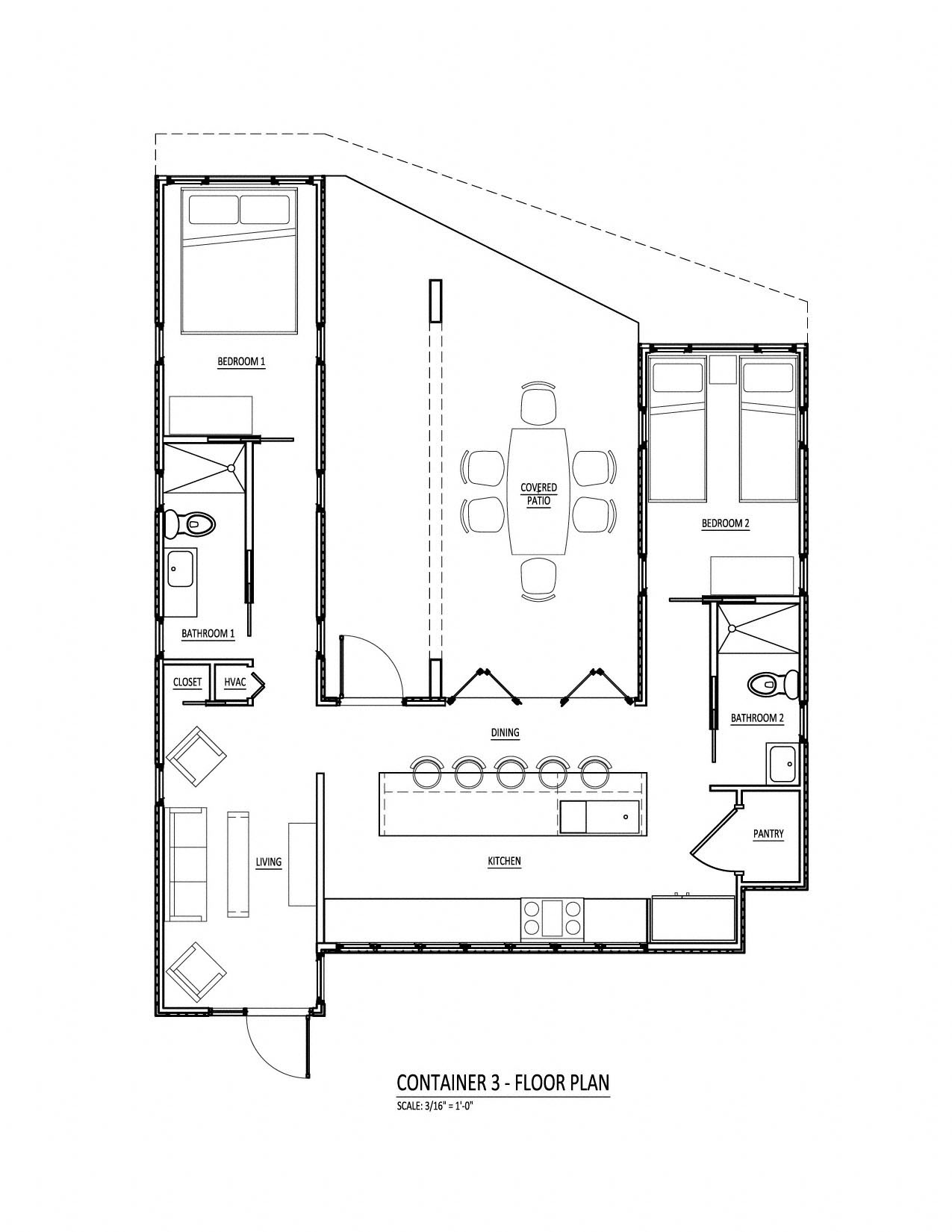
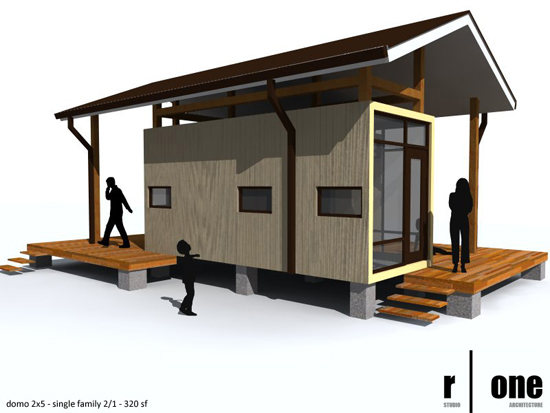
This can be  a real challenge for many architects and designers who are used to designing homes and spaces that, quite frankly, are much larger than required for the average user.  For example, a single 20′ container can be designed as a single unit, or pod, to include a single bedroom and bathroom while another 20′ container can be designed as the public portion of the home.  By putting these two containers together, you get a 1 bedroom, 1 bath home that can be built quickly and, depending on the quality of finishes, very afford-ably (think IKEA, Home Depot and Target).  This is even the type of home that, given some basic construction knowledge and the help of a few close friends, can be built by the homeowner, saving thousands in labor costs. 

1 br/1 bth container home - 320 sf - entry view

1 br/1 bth container home - 320 sf - side view

Using the same design above, but instead using 40′ containers, we have an example that perhaps gets closer to what would be considered a “real home” that, as my wife puts it, “normal people would want to live in”:  a home with 2 bedrooms, 2 bathrooms and all the “bells and whistles”, so to speak, but still in only 640 sf (conditioned). Looking at the above model you can even see the opportunities for sustainable technologies that can easily be added to reduce or remove this home’s dependence on fossil fuel energy.  Solar panels can easily be incorporated into the gable roof, rain water can be collected and stored underneath, passive heating and cooling can be used by carefully placed openings (depending on location).  Because of the small square footage, less energy will be required within the space anyway, so your investment in sustainable tech will be less as well. 

I know, you’re thinking “640 sf is not enough space to house 2 bedrooms and 2 baths and still have comfortable living spaces.”  Well, I say to you, think back to your first apartment.  My first apartment was just over 900 sf and it was HUGE!  2 bedrooms, 2 bathrooms, living, dining, kitchen and a deck.  Way more space than I needed and I’m sure with a little finesse I could have added a third bedroom in there easily. 

The moral of our little tale here is, containers allow architects and designers to think differently about how space is used and organized for optimum use in minimal square footage.  We still have to abide by our state and federal building codes and accessibility requirements, this goes without saying, but think about the last house you designed – where could you have saved some square footage without sacrificing function, design and style?  I’m betting you’ll be surprised if you think about it critically for a moment. 

While I was writing this article a friend of mine sent me this small article that offers photos of some container projects from all over the world, both commercial and residential.  These projects are real, they’ve been built and they are successful, i.e. people WANT to live in them. 

The Daily Green 

Used shipping containers provide an affordable building block for any type of construction project, but especially for single family and multifamily homes because they can be purchased inexpensively, assembled quickly and, depending on how you choose to insulate and finish, constructed into a finished building in less time with less expense than conventional construction. 

.

  • Pingback: Tweets that mention Shipping Containers – a design primer | Life of an Architect -- Topsy.com

  • http://SLS-Construction.com SLS Construction

    Wow, I am actually the first commenter… as a builder I love the idea of being able to use a waterproof enclosure designed to handle heavy load loads & winds. Unfortunately the pictures from The Daily Green, do not show how well these units can be utilized. and can blend into a neighborhood with a little cosmetic work. If I get a chance later, I will try finding some of the links I have collected on how others have utilized them & the great results.

  • http://SLS-Construction.com SLS Construction

    Wow, I am actually the first commenter… as a builder I love the idea of being able to use a waterproof enclosure designed to handle heavy load loads & winds. Unfortunately the pictures from The Daily Green, do not show how well these units can be utilized. and can blend into a neighborhood with a little cosmetic work. If I get a chance later, I will try finding some of the links I have collected on how others have utilized them & the great results.

  • http://SLS-Construction.com SLS Construction

    Wow, I am actually the first commenter… as a builder I love the idea of being able to use a waterproof enclosure designed to handle heavy load loads & winds. Unfortunately the pictures from The Daily Green, do not show how well these units can be utilized. and can blend into a neighborhood with a little cosmetic work. If I get a chance later, I will try finding some of the links I have collected on how others have utilized them & the great results.

  • Jeremiah Russell

    Sean,
    It’s true, a lot of what you see in the area of container construction is either hyper modern or hyper “rustic”. I myself haven’t seen much of the in between “traditional” container architecture. It’s out there, but it’s terribly few and far between. I’ve got several examples of more modern designs on my blog (nothing built yet unfortunately). Thanks for the comments! Looking forward to some of those links.

  • http://twitter.com/Alexandrafunfit Alexandra Williams

    The first home I owned was 700 sf and it was plenty big enough for 2 adults & a baby. Got too small when the 2nd baby showed up, but that’s a remodel “add a 2nd floor” story. It’s an intriguing concept – not sure I’m ready to live in one though.

  • Jeremiah Russell

    Alexandra, is there a specific apprehension you have about living in a home designed with shipping containers?
    I agree with you about the 700sf. My current home is about 1200 sf and is inconvenient only because it’s not currently organized for the way we live. But that’s changing little by little.

  • http://SLS-Construction.com SLS Construction

    Unfortunately I can’t find the folder they were in – as one of them had a step by step plan & pictures they used including tricks for joining 3 of them side by side for one large great room.

    With that said I did find a few just dropped into my sort folder:
    Awesome animation of a guys dream home: http://isbudepot.com/
    Some great examples of built ones by Kelly Hart: http://www.greenhomebuilding.com/articles/containers.htm
    One I know Bob would love: http://containerhomes-info.com/images/demaria_redondo-10.jpg
    An interesting set from Costa Rica which points out that even a single width one – can be done up almost anyway you like. http://tinyhouseblog.com/pre-fab/shipping-container-homes-in-costa-rica
    Along those lines – for those that like RVing and have drooled over some of the newer models, there’s nothing that says you can’t outfit one of these like them
    A list of more resources: http://containerhomes-info.com/shipping_container_resources.htm

    By the way, for your diagram on the inside – you might consider simply attaching 3/4″ furring strips to the ribs, doing your roughin, spraying closed cell foam, and attaching drywall to the furring strips – you will only loose a little over an inch of height & 2.5 inches of width inside each container

  • http://twitter.com/ecomod Becky Shankle

    We’ve been doing some kitchen concepts for containers over the last few weeks. Modular + modular = match made in heaven! :)

  • Anonymous

    Jeremiah, this just came up today as I was talking to a potential client who had a shipper container in the back of his manufacturing facility. I’ll have to share this with him. I love the idea. I may have to make a studio out of one. Except don’t “dress it up” leave it raw and honest. Don’t worry about what “normal” people want to live in!

  • Anonymous

    Jeremiah, this just came up today as I was talking to a potential client who had a shipper container in the back of his manufacturing facility. I’ll have to share this with him. I love the idea. I may have to make a studio out of one. Except don’t “dress it up” leave it raw and honest. Don’t worry about what “normal” people want to live in!

  • http://www.facebook.com/people/Container-Home/100001572272233 Container Home

    Can I suggest another two resources.

    These are the most focused on providing real training materials on the subject.

    http://www.isbu-info.org – The official site of the ISBU Association.

    and for a bit of shameless self promotion – Shipping Container Homes

  • will

    I am an open-minded skeptic. The idea has been an architects’ obsession for many, many years, yet to my knowledge has not significantly impacted the housing or construction market. I would guess there are a few reasons for that, but I would also ask the author what the true cost comparisons of purchasing a shipping container, having it shipped to the site, placing it with crane, cladding it, etc, versus a comparable cost for stick built construction of a 40′ x 7’6″ space? I tend to believe that the ultimate economics of this don’t make sense, otherwise, why haven’t market experts (those who manufacturer prefab, trailer type homes), ever moved in this direction?

    Additionally no matter how you shake it, the interior width of a shipping container (7’6″) is not an ideal living space. Just take a look at those bedrooms in the plans above – a tube is not a nice space to occupy – and carving up a container to make it a nice space probably eliminates any economic advantage which may exist.

    Just some food for though.

  • Jeremiah Russell

    So Will, you’re “open-minded”? :-P It is true that using a single container as a home is not ideal. Hell, modular construction is not for everyone either – hence the McMansion housing boom in this country over the last 60 years or so. BUT, re-purposing shipping containers for use as residential homes is doable at an affordable cost. You figure, currently, a used 20′ container costs in the range of $800 – $1500 depending on condition. $1500 will get you a nice weather tight container delivered to your site. At 160sf that’s a cost of just over $9/sf for your structural envelope. Now all you have to do is cut openings, install insulation, furring, flooring (basically all your finishes) and voila! Home Sweet Home. Level of finish and detail will greatly determine cost. Consult RS Means for current costs on basic wood furring and spray foam insulation, concrete, etc.
    Also, the charge that a 7′-6″ wide space can’t be comfortable is a relative statement. For you it may be damn uncomfortable. But for someone else it may be just fine. We’re talking about lifestyle choices here, which are many and varying. The choice to live in less space does not mean you have to live with less style or comfort. It’s all in how you design the spaces. The above floor plan is enough space for a couple with one child to live, entertain and generally be merry – it’s all a matter of perspective.

  • will

    I actually am open-minded, meaning capable of being convinced. Not there yet and trying to work through the logic-

    So relative to material costs, the metal container is equivalent to the cost of studs, joists, and sheathing+labor to assemble. From your details, both systems are then similarly treated with insulation, cladding, finishes. How are the containers moved from truck to foundation?

    I live in a 600 sf NYC apt, which was a step up from my previous 300sf apt. I understand living in small spaces. From that experience, I can say that a 7′-6″ room is not comfortable for most people, even in NYC.

    Certainly this has a niche market, but the idea has been around for as long as I have been following architecture, see Wes Jones, LOTEK, etc and container houses must still be a miniscule component of even the prefab housing market – just trying to brainstorm why, with the advantages you lay out, this hasn’t taken off on a larger scale.

  • Jeremiah Russell

    Containers are typically placed with a crane truck onto foundation (foundations being poured and cured before delivery) and welded together.
    As far as why it has never blown up in the mainstream market? No idea. I can say there are more than just a few designers out there offering home designs using containers, so it’s not so much a “niche” as a more specialized architectural style? I think as more and more people are coming to “downsize” their lives, this type of construction will become more and more popular.
    Oh, and you should get over the 7′-6″ thing. The above floor plan was a design that I did to showcase “smaller” living. Containers can be used for more “typical” homes as well. Take 2 40′ containers, side by side then stack 2 more on top and you’ve got a 16′ x 40′, 2 story home. I think Inhabitat currently has a project on there blog that is a 16′ wide modern home (not containers, but still).

  • Andrew

    Okay, you asked. We did a post on shipping containers a while back too, and here’s what we think http://blog.buildllc.com/2008/06/shipping-containers/

  • http://pulse.yahoo.com/_62IW5KKDO56PJJTDLJVMDRYCUA Gene

    I think many are close minded in the design of a home from shipping containers, including the architects and designers. Many seem to head into the design with the thought that the finished product has to “look” like it was built out of shipping containers. Although great for PR or to make a “splash” for the architect, a home built in this way can be made to look like any other home in the area.

    Also, there seems to be a need for architects and designers to “think outside of the box”. The whole home need not be contained within the walls of a shipping container pod. The ISBUs can be attached to the foundation at a distance from each other and the space between be framed out by other materials, such as cordwood masonry or (my choice) hempcrete. Any building material could be used for this purpose, as long as it could make a good seal against the edges of the shipping containers. Add a pitched SIP panel roof with a steel roof above that and you have an added insulation barrier above the home and a great way to add solar panels above.

    I’m not an expert in construction, architecture, or design, but I have done a lot of research on building with alternative materials, especially ISBUs. If the professional mindset for using them for homes could drop the idea of looking futuristic and meld traditional construction appearances with the use of ISBUs as the framing, we would have beautiful living spaces made from them.

  • http://www.facebook.com/people/Container-Home/100001572272233 Container Home

    Fascinating discussion.

    I would like to add a different perspective here.

    I live in SE Asia and feel I have done as much as anyone to further the cause of Shipping Container Homes as affordable housing solutions in developing countries.

    One of the reasons that Shipping Container Homes haven’t gotten the traction many ( including myself ) originally thought they would is they are actually work out to be far more expensive to construct than an equivalent modest, well thought out solid brick and reinforced concrete home in most places in the World.

    I understand these numbers are going to get thrown out of balance if we try transplanting the discussion to the US or but the US is not the World and this is a Global discussion.

    If we put aside all building codes and just work on a common sense basis – ( there are no building codes in most developing countries ) – then this is how we build an affordable safe solid and durable home without containers for $5000 USD in SE Asia ( Thailand, Burma, Laos, Cambodia and Vietnam )

    BTW the Habit for Hummanity Home budget is $4000 per home where I live ( I am not connected its just presented as “high profile” example )

    So the house has

    Reinforced Concrete Slab – No floor finishes required the concrete can be “ ground and polished ”

    Locally produced Soil Cement Stabilized Blocks for both external and internal walls.

    http://www.containerhome.info/public-images/reinforced-soil-cement-block.jpg

    No Insulation – In most developing countries insulation is not used.

    The walls are not dry walled just solid rendered over the block inside and painted

    The blocks can carry conduit for water and power inside the holes provide for vertical and horizontal ( ring beam ) steel reinforcement.

    Doors and Windows and other fit out items are like for like equivalents regardless of construction technique.

    A simple steel framed gable roof and fibre cement roofing sheets – which is also like for like – a shipping container home must have a roof.

    Here is the $5000 house.

    http://www.containerhome.info/public-images/soil-cement-house.JPG

    So when you consider

    Local labor forces understand and are currently geared for reinforced concrete slabs
    Local production of soil cement blocks are well under way in most countries and assembly on the house site is “non skilled” labour because it’s a motarless system. You stack the blocks, line them all up and when its perfect you pour concrete down the holes.
    No special equipment is required for modification or transport of containers
    No new skills are required for modification or transport of containers
    Anyone that has ever seen motar less blocks go together as intended would struggle to argue the time advantage.
    No furring out required
    No dry wall or similar is required
    No cladding is required
    No insulation is required – clearly this climate dependant but you must insulate a Container Home in the same location as a non insulated block home.
    Both are super strong – properly constructed stabilized cement soil blocks have a compression capability of 100 tons, they make multistorey high rises out of these.

    And it “looks” like a traditional house so has immediate “acceptance” – ok its humble but anyone that cant see that its $5000 and we can pretty it up with a bigger budget lacks imagination.

    So they are both robust and fast and affordable and one could argue the greenest house of all is the house that doesn’t use green materials, it the one that just uses less materials.

    All this and I teach people to build with ISBU’s ! Strange huh ?

    The challenge is that many people are coming at this from the wrong angle and “price” isn’t the real benefit of Shipping Containers.

    In my opinion the real legacy of container homes will be the ultimate uptake in a % of the market of a simple, easy to understand reconfigurable, expandable, relocatable, heavy gauge steel modular housing solution.

    So if we can do all this for $5000, what could we do in the US with an “open mind” and inspired thinking ?

  • http://twitter.com/ExtremelyAvg Brian Meeks

    I have many dreams in life; to be a novelist, hang out in the grotto with Hugh, and to design my own shipping container home (possibly a shipping container castle). I am not an architecht, though I do tweet with some very good ones. I have also thought it would be fun to have an iceberg house out of shipping containers. Three containers above ground, with a dozen or so below ground.

    For me, the only reason I want to build something out of shipping containers, is my love of Lego building blocks. If it is slightly cheaper, then all the better. If it is green, that is good too. But mostly I want to satisfy my childhood love of playing with the bright colored plastic blocks.

    Great post! I loved it!

  • http://twitter.com/ExtremelyAvg Brian Meeks

    Again, I am not in the industry. The only reason I want a shipping container house, is I think it is just incredibly cool. I would pay extra to use them, if I had to. Who cares about ‘economic’ advantage. Give me a shipping container home, with solar panels, some vertical windmills, and hooked into geothermal, and I am going to be giddy.

    It should be noted that I am a complete nerd, single, no kids. Obviously, my opinion isn’t main stream. So when I say ‘Who cares’, I realize that 99.7% of people would care. I just love them so much I am biased.