
A quick look at your calendar can tell you exactly where you’re supposed to be throughout the day. Finding time to complete the work you’ll be discussing in those meetings might require a little more investigation. The conversations are necessary and people need answers, but being available to help everyone else doesn’t get your own assignments finished. Schedules are supposed to organize our efforts, yet accommodating the people involved can leave very little room for the work those commitments require. Eventually, the office empties out and you finally have time to concentrate, assuming you didn’t have anything else planned for your evening. Getting everything done has a cost, and agreeing to a schedule doesn’t always mean you had much say in creating it. Welcome to Episode 212: Schedules: Who Owns Your Time.
[Note: If you are reading this via email, click here to access the on-site audio player] Podcast: Embed Subscribe: Apple Podcasts | Spotify | Android | iHeartRadio | TuneIn

Today, Andrew and I are going to be taking a look at schedules and how they give us some idea of what to expect from our days, at least until the day actually starts. Most of us have a plan for the week, and there’s some comfort in knowing what needs to happen and when. The difficulty is that the calendar includes the things we know about, while everything else gets introduced as we go. I’m moving this week, so packing and coordinating the move have become another set of obligations that need to fit around the work already scheduled at the office. Preparing this episode and finding time for us to record it are part of that same exercise, and none of those activities make the office responsibilities go away. The plan still exists, but its success depends on a fairly optimistic belief that nothing else will need attention. That’s where I think schedules get interesting, because we use them to create some order even though we know the day probably won’t unfold exactly as planned.
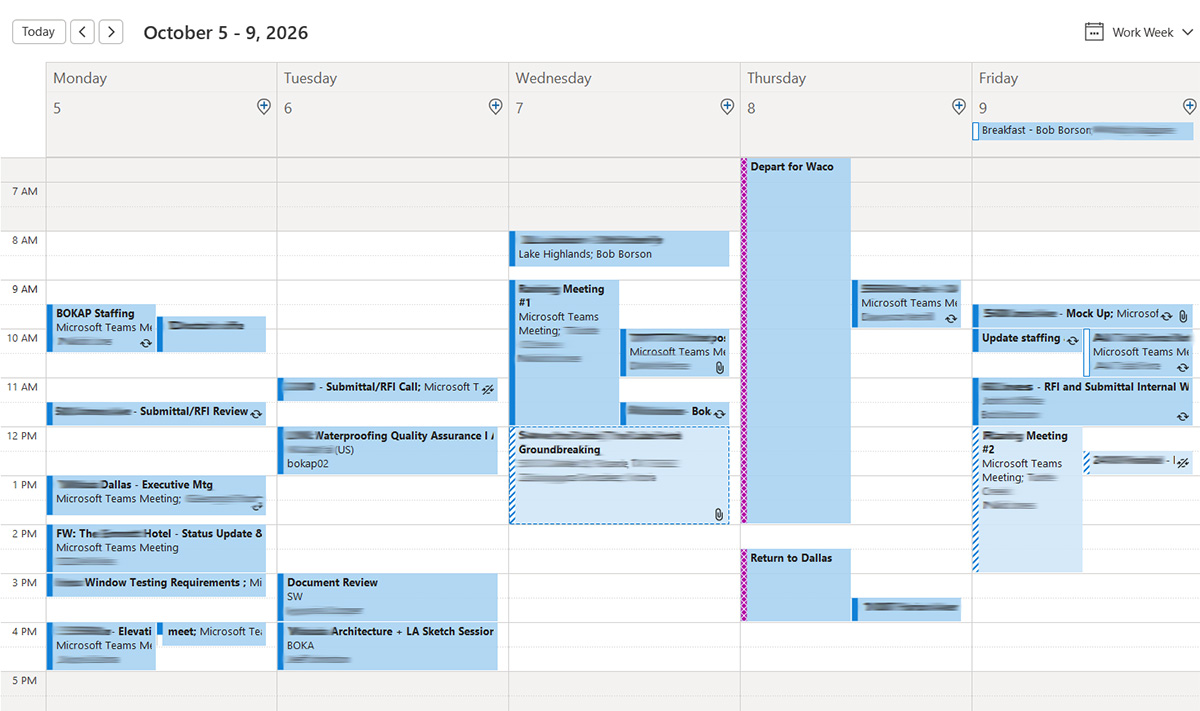
My week – this was last week, the week of October 5th, although that doesn’t really matter, all of my weeks all look like this one so this wasn’t special. Over the course of those 5 days, I had 25 meetings, and there were 204 people in those meetings.
Monday – 7 meetings (3 internal)
Tuesday – 4 meetings (2 internal)
Wednesday – 4 meetings (1 internal)
Thursday – 4 meetings, which was exceptional because I was left my house at 6:30 am to drive to an OAC meeting at 9:00, and I didn’t get back to Dallas until 4:00 … and then I had 3 more meetings that day. (0 internal)
Friday – 6 meetings (3 internal)
I want to revisit the Maker’s / Manager’s Schedule Conept for a moment before we jump into things …
We’ve talked about the Maker’s Schedule and the Manager’s Schedule on the show before, but a little background would probably help before I explain why I would like one and apparently have the other. The distinction comes from a 2009 essay by Paul Graham, a programmer and cofounder of Y Combinator, which helps startup companies get off the ground. His observation was that people who manage work and people who make things need different arrangements of time. A manager’s day can be organized into appointments, often an hour at a time, while a maker needs longer stretches to get into something that requires sustained concentration. Graham uses writing and programming as examples, but working through a building design belongs in that conversation as well. A meeting halfway through the afternoon takes more than the hour assigned to it because it divides the remaining time into pieces that might be too short to do the work you intended. That helps explain why an open spot on someone’s calendar doesn’t necessarily mean they have nothing happening during that time.
The appeal of a Maker’s Schedule is fairly obvious to me. Spending the morning working through a design and the afternoon attending to meetings sounds like an excellent arrangement, and I would be happy to begin as soon as everyone else agrees to organize their day around mine. That seems to be where we keep getting stuck. Most of the architects I know need to do both kinds of work, and their ability to separate them depends on people who have their own schedules to consider. A very small office might have fewer people to coordinate, or a role with fewer demands might offer more control over when the work happens. My calendar, however, includes meetings scheduled around the availability of the group, and the questions arriving at my desk generally come from someone trying to keep a project moving. Explaining that I am currently enjoying the maker portion of my day would probably be less helpful than I might hope. Graham’s distinction gives us a useful explanation for why interruptions cost us more than the minutes spent answering a question. What it doesn’t give me is much ability to prevent them. The uninterrupted time still has value, but getting it often means working before everyone arrives or after they leave, which brings us right back to finding more hours in a day rather than having much control over the ones we already have.
(The book I talked about was Irving Stone’s “The Agony and the Ecstasy” and is one of my all-time favorite books)
Who Sets the Schedule jump to 16:53
A project schedule gives everyone involved something they can plan around. The client knows when to expect the next round of drawings, and the consultants know when they need to provide information so someone else can keep working. Those dates matter because our work is connected, and leaving everyone to get around to their part whenever it feels convenient would make delivering a building considerably more difficult than it already is. The challenge is that agreeing on a schedule involves people whose needs don’t necessarily line up. A client might need drawings by a particular date for reasons that have very little to do with how long it takes to prepare them. Those reasons can be legitimate, especially when financing or a construction start is involved, but the work still requires time. The client’s need for a date and the architect’s ability to meet it have to be considered together, which sounds fairly obvious until you are the person explaining why the requested date presents a problem. Suddenly, describing what needs to happen can sound like you are making excuses for why it can’t happen. Most of us want to be helpful, and we understand that our clients have obligations of their own, so we start looking for a way to make the schedule work. The question is whether we are agreeing to something the team can reasonably accomplish or assuming that we will figure out how to accomplish it later. Those can look identical on a calendar, although they represent very different commitments for the people doing the work.
Control over your own calendar might seem like something that should improve as you gain experience and responsibility. I certainly thought that would be one of the benefits, although my calendar would suggest that I misunderstood the offer. Earlier in your career, someone might assign you a task and a date for completing it, and a substantial part of your responsibility is working through that assignment. More responsibility can give you greater influence over how the work gets done, but it also introduces more people who need you to participate in their work. My role gives me some authority to make decisions, yet those decisions frequently require conversations that happen when other people are available. A meeting time that works for most of the group is generally a sensible choice, even when it breaks up the only stretch of time I had to work on an assignment. Nobody has to be unreasonable for that conflict to exist. The complication comes when several groups make equally sensible decisions about the same person’s day, and each group sees only the portion of the calendar relevant to its needs. The work that person was supposed to complete still has the same deadline, which means having some authority over a project can coexist with having very little control over the time available to manage it.
Being Available is Part of the Work jump to 30:02
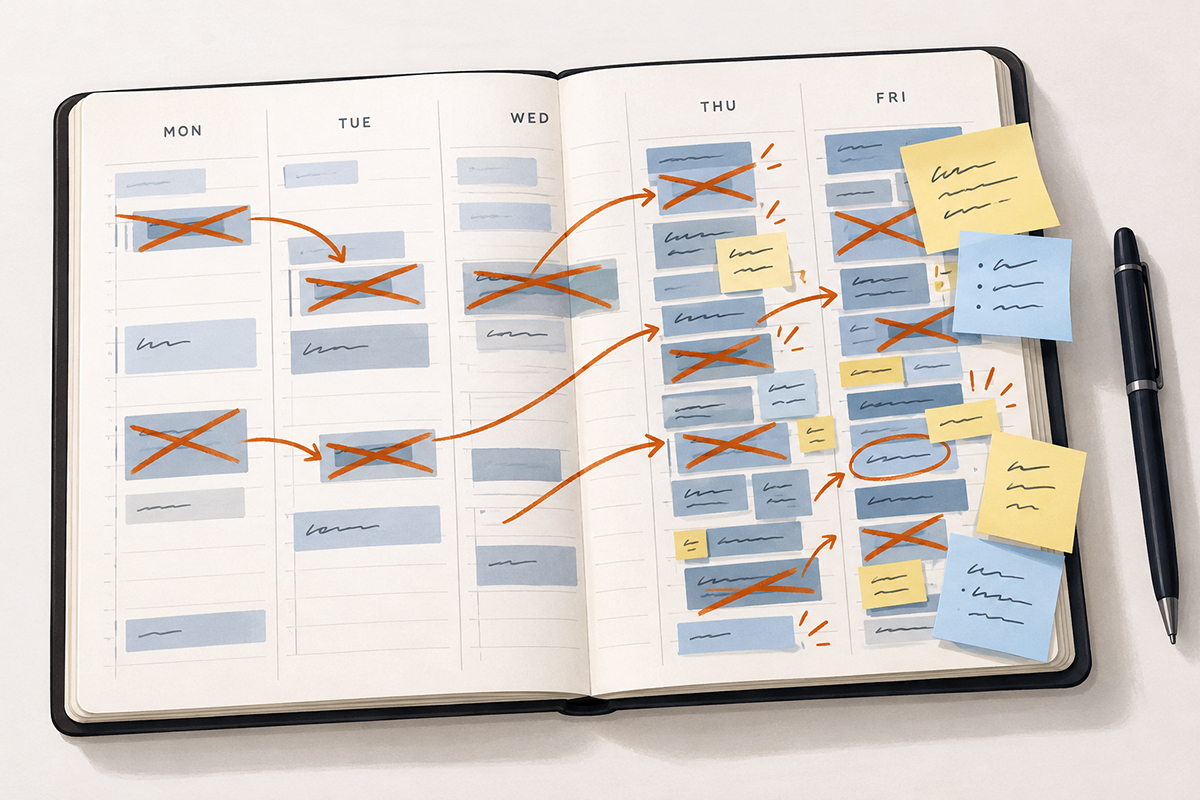
Being available to other people is part of the job, especially when your experience allows you to answer a question that would otherwise keep someone from moving forward. It is easy to talk about interruptions as though everyone approaching your desk has wandered over because they’re bored. Most of the people coming to me actually need something – presumably beyond whatever is left in the candy bowl on my desk – and there is usually a reason they need it now. A team member might have reached a point where continuing without an answer means risking several hours of work on the wrong solution. Taking a few minutes to review the issue is a reasonable use of my time, and telling that person to come back in three hours because I have blocked out my calendar doesn’t necessarily serve the project. The difficulty is that being available requires you to leave whatever you were doing, work through someone else’s problem, and then find your place again. The person who received the answer can return to work, while you are still trying to remember what you were considering before the question arrived. Repeat that process throughout the day and you can be useful to a great many people without finishing the assignment you started that morning. Blocking out time sounds like a sensible response, but an appointment with yourself offers limited protection when your role includes helping people through problems they cannot resolve alone. The need doesn’t disappear because the calendar says you’re busy, and deciding which demand deserves your attention becomes another responsibility.
Delegating work helps distribute the effort, but the difficult decisions can still come back to the person accountable for the outcome. I trust the people on my teams and can hand off substantial responsibility, yet when the path forward is uncertain and money is involved, there are conversations I still need to join. My firm leadership responsibilities and project management responsibilities operate independently, and neither seems particularly interested in whether the other has already ruined my afternoon. That is part of why working early or late has become useful to me: there are fewer people who need an answer, and I can stay with an assignment long enough to advance it. Working from home changes the frequency of those requests as well, simply because people don’t see me sitting there. Those experiences suggest that uninterrupted time makes a difference, but obtaining it by extending the day creates its own problem. A day spent making decisions and helping the team is still a working day, even when the result is difficult to point to on a drawing. The scheduling challenge is accounting for that contribution while also allowing time for the assignments you are expected to complete yourself.
When the Schedule Changes jump to 39:01

One of the things making schedules more difficult lately is that getting permission to start a project doesn’t seem to mean we will get to keep working on it. We prepare a concept package, send it over, and then the project goes on hold. Eventually, we get approval to move into schematic design, complete that work, and find ourselves waiting again. I understand that there are decisions being made during these pauses, and some involve spending a considerable amount of money. I would probably want a moment to think about that as well. The part that gets complicated is what happens while the client is thinking. The people working on the project move to other assignments, and the consultants do the same because nobody can afford to keep a team available indefinitely. Once approval arrives, everyone is understandably interested in making progress, but now we have to see who can actually get back to work. Some people can adjust, while others have commitments they can’t easily move. A revised date also means reviewing where we stopped and whether anything has changed since the last time we were all paying attention to this particular project. None of that is especially surprising but explaining it to someone who has already spent months waiting can make you sound remarkably unhelpful. The client finally says go, and our response is to explain why going might take a little longer. I can see why that conversation doesn’t always get off to a great start.
Accommodating a project restart usually means rearranging work that already had a place on someone’s schedule. A client with a large project can have substantial dollars tied to a date, and a client with a small project doesn’t particularly care that we have other projects. Their project is the one they hired us to work on, which is a reasonable perspective. Unfortunately, several clients can have that same reasonable perspective at the same time. We generally try to make the requested schedule work, but agreeing to the date is only the beginning of figuring out how to meet it. The other deadlines are still there, and moving work from one week to another can leave you trying to explain a scheduling problem to someone whose project never went on hold. They would understandably like to know why any of this has become their problem, which is a question you might also be asking yourself.
The Cost of Making it Work jump to 45:46

Meeting a difficult deadline can leave everyone with the impression that the schedule worked, which is understandable if the drawings arrived when they were supposed to arrive. The client got what they needed, and whatever happened to make that possible is mostly an internal matter. The problem is that delivering on time doesn’t tell us whether the work fit into the hours available or whether someone spent their evening making up the difference. I leave for the office early, partly to avoid the regular morning traffic and partly to get there before the questions arrive. That stretch of time gives me a chance to stay with an assignment long enough to make progress before being available to other people becomes part of the day. More recently, I have also been trying to leave the office early so I can get home and reclaim some of that focus time. There is a traffic consideration there as well, because sitting on the interstate at five miles per hour is a fairly irritating way to spend time you already feel short of. Working at home lets me continue an assignment without being visible to everyone who might need an answer, and the intention is to finish the work without donating most of my waking hours to the job. I’m still working, but I’m trying to arrange the day so more of those hours produce the progress I need. Otherwise, come 5:00 or 6:00, I can have spent the day in necessary conversations and still be looking at the assignment I intended to finish that morning. I know that helping other people has value, yet I can still wonder what I actually accomplished. The person making that assessment is generally me, and I have apparently decided that knowing all the circumstances is no reason to be more reasonable.
The time needed to finish office work has to come from the rest of your life, and some of that time already has assignments attached to it. I’m moving this week, so there are boxes to pack and arrangements to make regardless of how productive the workday turns out to be. A less eventful week still includes buying groceries and washing clothes, neither of which seems particularly impressed by a drawing deadline. We choose some obligations because they matter to us, but having priorities doesn’t mean every demand can be neatly arranged around them. Sometimes you leave something on the to-do list, and sometimes you stay up later because tomorrow doesn’t appear to have any more room than today. Those are decisions we all make, and occasionally accepting that cost is how we get through a demanding period. The difficulty is recognizing when making up the difference has become the normal arrangement, because getting the work delivered tells us very little about what was left undone to deliver it.
Making a Responsible Commitment jump to 51:23

Making a commitment to a schedule requires some understanding of what has to happen for that commitment to be possible. That sounds obvious, although most of us have probably agreed to a date while mentally moving several other things around and hoping nobody asks too many follow-up questions. We want to be helpful, and explaining every complication can make a fairly straightforward request sound like the opening of a hostage negotiation. The useful conversation is about the conditions that affect delivery. If we need a client decision before the consultants can proceed, that decision needs a date as well. If a project is restarting, we need to confirm when the people doing the work can return to it. Those are parts of the schedule, even when the only date anyone wants to discuss is the one at the end. My inclination is generally to accommodate the request, but there is a difference between saying we will make every effort and having enough information to promise that the work will be finished. A responsible commitment means working through that difference before everyone leaves the conversation with a different understanding of what was agreed. The client should understand what we need to deliver, and we need to understand why the requested date matters. Sometimes that discussion reveals room to adjust the delivery or agree on which portion of the work is needed first. Sometimes it confirms that the date is firm and we have a difficult stretch ahead. Either answer gives us more to work from than agreeing to Friday and waiting until Thursday to discover that everyone had a different Friday in mind.
Accepting a demanding schedule can still be a reasonable decision, particularly when there are consequences to missing the date that justify the additional effort. There are also situations where the options are limited and the work simply has to be done. I don’t think every one of those situations comes with a solution that can be found by being more organized, and I am fairly certain another color on my calendar won’t resolve it. What we can do is be more honest about what making the schedule work requires. We should account for extra hours when we consider the effort involved, and any work moved to accommodate one project needs to stay part of the conversation about the others. That recognition matters even if it doesn’t change the immediate assignment. Once the deadline has passed, we can look at whether the additional effort came from an unusual circumstance or from an assumption we keep repeating. We might decide that the cost was acceptable, but it deserves to be a decision rather than something concealed by the fact that the drawings went out on time. Good service includes keeping our commitments, and understanding how we kept them gives us a better basis for the next promise.
Making Ep 212: Schedules – Who Owns Our Time
Schedules give us something to plan around, even when the day has other ideas. Most of us want to be helpful and keep our commitments, so we find a way to get the work done, occasionally by borrowing time from an evening that already had plans of its own. The part I want to pay more attention to is what making a schedule work actually requires. Before agreeing to a date, we can ask what needs to happen and whose contribution we’re counting on, then discuss what accommodating that date will change. We may still have to work through a difficult situation, but meeting the deadline shouldn’t erase the effort it took or convince us that the same arrangement will always be reasonable. I also need to remember that a day spent answering questions and helping other people move forward counts as work, even when my own to-do list remains annoyingly intact. The next time we look at a completed schedule, it’s worth asking what it cost to follow it, because that answer should have some influence over the next one we agree to.
Cheers,

Special thanks to our sponsor, Construction Specialties, maker of architectural building products designed to master the movement of buildings, people, and natural elements. Construction Specialties has been creating inspired solutions for a more “intelligently built” environment since 1948. Visit MasteringMovement.net to learn more.