
Architecture is a long-game profession. It takes years to create a foundation of knowledge required to do our work. It begins in school and continues through your early career, and peaks after many years in the profession. As architects, we never stop learning, so it could be later in life when you feel the most confident about your abilities and knowledge as an Architect. So what happens to this experiential knowledge? What happens when we leave the building due to retirement? Does this get passed to the upcoming generations? Should it be? Does it even matter? Welcome to Episode 197: A Knowledge Gap? (question mark)
[Note: If you are reading this via email, click here to access the on-site audio player] Podcast: Embed Subscribe: Apple Podcasts | Spotify | Android | iHeartRadio | TuneIn

Today’s topic was born out of our last conversation about retirement. As you might have imagined, that episode got me thinking about the end of a career and what that looks like and how it happens. So I was having a conversation with a colleague, and we got onto this topic of all the knowledge that leaves when someone retires. The conversation was about teaching and the many years and knowledge of teaching experience that are lost when a long-standing educator retires. No matter what the subject matter, there is a wealth of knowledge that can disappear overnight, and it usually does.
So this put me on a path to find out what does happen. What are the best ways to transfer this knowledge? Is it even possible? Then along the way, I found some rather alarming information that made it seem like there is a looming crisis in many professions at the moment; years of experiential knowledge are leaving as the Boomers and even Gen Xers move into retirement. There is an onslaught of retirements coming in the next several years as most of the Boomer generation retires, and many of the elder Gen X professionals are not far behind. So I did some investigating and discovered several elements that became part of this discussion. So to that end, I have simplified a complex discussion into four ideas: the demographics, mentorship, professional knowledge, and what gets lost.
So, there is an idea that a looming knowledge gap is headed toward our profession and many other professions as well. But I will place some stress on the idea of adding the word “possible” to this statement.
The Demographic Reality jump to 3:19
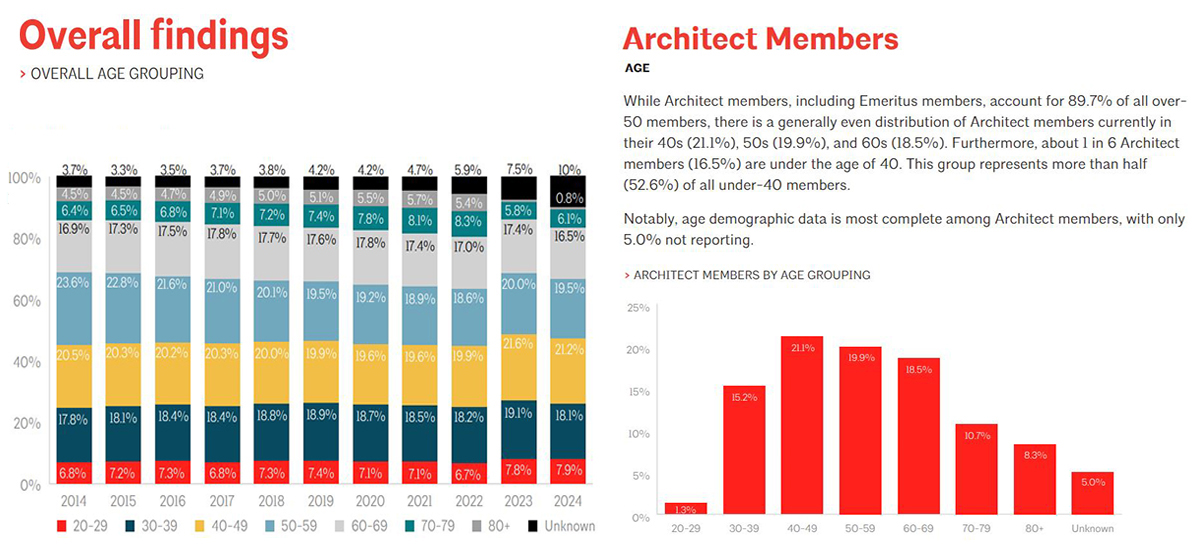
So let’s start by looking at some numbers and statistics. According to AIA & NCARB demographic research, the median age for architects is 51 years old. For doctors, it’s actually higher at 54, Lawyers are lower at 42, Engineers are also lower at 42, and Software Developers/Engineers are at 39.8/40.
So we are more aligned with doctors. They have over 46% over 55. And 25% over 65. While we are not that old, we are not far behind. Yet if we compare ourselves to the Software Developers, who are both creative and technical, much like architecture, they are a much younger STEM group by comparison.
Now there are two sets of demographics available here, so if you Google this, you might get a different answer. The Bureau of Labor Statistics (BLS) shows all of these numbers as being lower. It states that an Architect has a median age of 45.6 and doctors/medicine at 46.7. But these are based on the total profession and not “licensed practitioners”, so that is the major difference. I would prefer to discuss the licensed numbers, as they are more relevant to this discussion. So I just wanted to get that out of the way early in this discussion.
So if we look to summarize some of the data I was able to gather…
The Architecture Profession is aging. The profession is approaching a large demographic turnover.
- The median age of architects is around 51, significantly older than many professions.
- In addition, 22% of architects fall between 55 and 64, meaning a large share of the profession is approaching retirement.
According to the recent NCARB and AIA numbers the data shows
- 64% are over the age of 40
- 42% of architects are over the age of 50
- 24% are over the age of 60
- 13% of architects are already over 65, which is traditional retirement age
While this data is trending fairly normal since 2014 (with some slight variances) there are a few larger issues that make this data actually more problematic. A big issue is that in 2024 the number of licensed architects dropped by 4%. (down to 116,000) a loss of 4600 architects. This represents the largest drop in recent history, not counting the depression of 2008-2010. This number of 4% was all attributed to retirement. That same year there were only 3600 newly licensed architects. That amount is an increase from the COVID years where it was in the 2000’s for several years. But (according to NCARB data) we are still not back to pre-COVID numbers for new architects annually. The good news is that number continues to rise.
Boomers (1946-1964) oldest 80 youngest 62
Gen X (1965-1980) oldest 61 youngest 46/47
The architecture profession is approaching a generational transition that will likely result in a significant loss of accumulated knowledge. This is not just about the retirement of the old guard of the profession, but about what will disappear along with them. Architecture relies heavily on experience, mentorship, and gained professional knowledge that develops over decades. As large numbers of senior practitioners retire, the profession could face a gap between the knowledge leaving practice and the knowledge being transmitted to the next generations. There are some other factors contributing to the alarm.
2008-2010 Great Recession
In July 2008 Arch firms employed appx 221,000 according to BLS & industry data. Then the great economic recession hit the US and world creating a large loss of the architectural profession’s work force. By July 2010 that number was 167,000; a loss of 24% . Several sources and articles from 2010-2012 provide the following:
- Most estimates have 20-30% of the workforce leaving during that 2 year period to never return.
- Those people at that time were mostly in the 5-15 years of profession range.
- This means those would be in the 40-50 year range today and would be helping the knowledge gap drop. But that large portion of the profession is missing.
So the group that would be there to fill the knowledge gap created by the Boomers and Gen-Xers exiting is actually a smaller demographic of the profession. Also this group is one that is reportedly feels unsupported and skipped over by the older generations. A few labor studies and surveys report this group feels largely underserviced by the profession.
2020-2021 COVID Pandemic
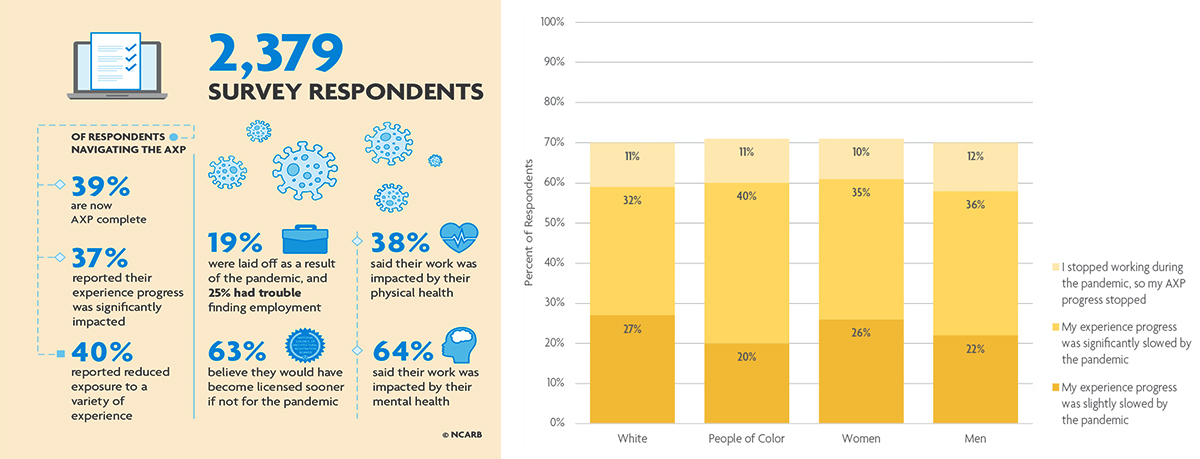
Another blow to the profession came with the COVID-19 pandemic. In 2020, there was a drastic drop in the number of newly licensed architects and the enrollment in architecture education programs. So that created a double whammy of damage to the pipeline that the profession is still working on to recover. According to NCARB data, newly licensed architects fell 40% in one year, the steepest single-year collapse NCARB had ever recorded. Also, 54% of candidates put their plans on hold while 60% say their career was permanently altered. The education system was also greatly impacted by the pandemic with large drops in enrollment for several years. Most of those have bounced back, but not all. The higher education system is in its own crisis right now also on the heels of pandemic recovery. Both of these issues compound the problems.
So, due to several factors, beyond just the aging of the profession, a few societal conditions also have impacted the professions knowledge trajectory.
The Mentorship/Apprenticeship Gap jump to 13:56
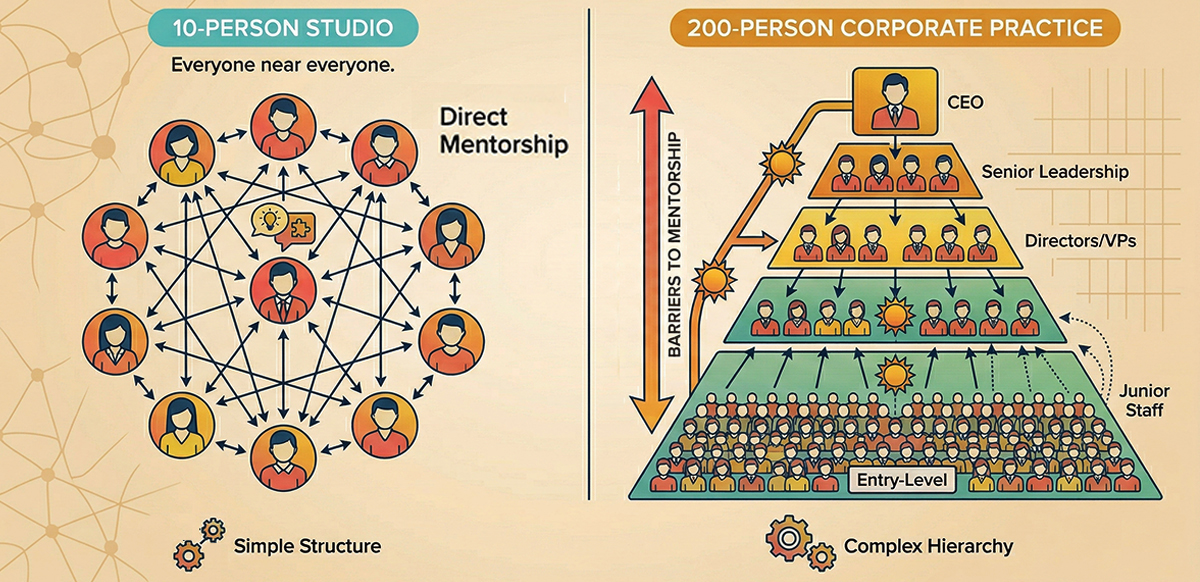
So why might this group of the profession, and even those after, feel so unsupported. Well, historically, architecture firms operated through apprenticeship culture. But this is no longer truly the case despite any claims to cling to this concept. The realities of practice and industry have changed what this actually means. The original and historic concept was that younger professionals would spend years and learn by working alongside experienced architects who had decades of project experience, construction knowledge, institutional memory, and professional judgment that they would share in a daily and interactive methodology as daily life in the professional trenches required this exchange.
But now, several trends are directly weakening that transfer model. First, firms becoming more corporate and larger, with less direct connections. The small firm is declining in many markets. Second, faster project delivery schedules and the increased speed demanded by industry does not allow for that long and methodical transfer of knowledge over the course of years. Also with the shift to larger firm sizes, there is many more bodies between the experienced architect and those new to the profession. There could be as many as six to ten layers of positions between them. This in turn means less time and opportunity for mentorship. So third, mentorship now must be a set priority for theses larger firms. Even as a profession we know it is not always top priority for firms. Firms have to push for proper mentorship and apprenticeship models if they want to transfer the knowledge down the generations. The fourth element causing disruption to this is the evolution of digital workflows changing how teams interact (WFH, Part Time, contract work modes, etc.). Again this erodes the ability and opportunities for ad hoc and unstructured knowledge transfer. It is difficult to learn by osmosis when you are not in the office able to hear the chatter of projects. Or you workspace is on a completely different floor than the experienced professionals. Lastly, that notion of the speed at which a large group or groups of experienced professionals are retiring is accelerating or soon to be.
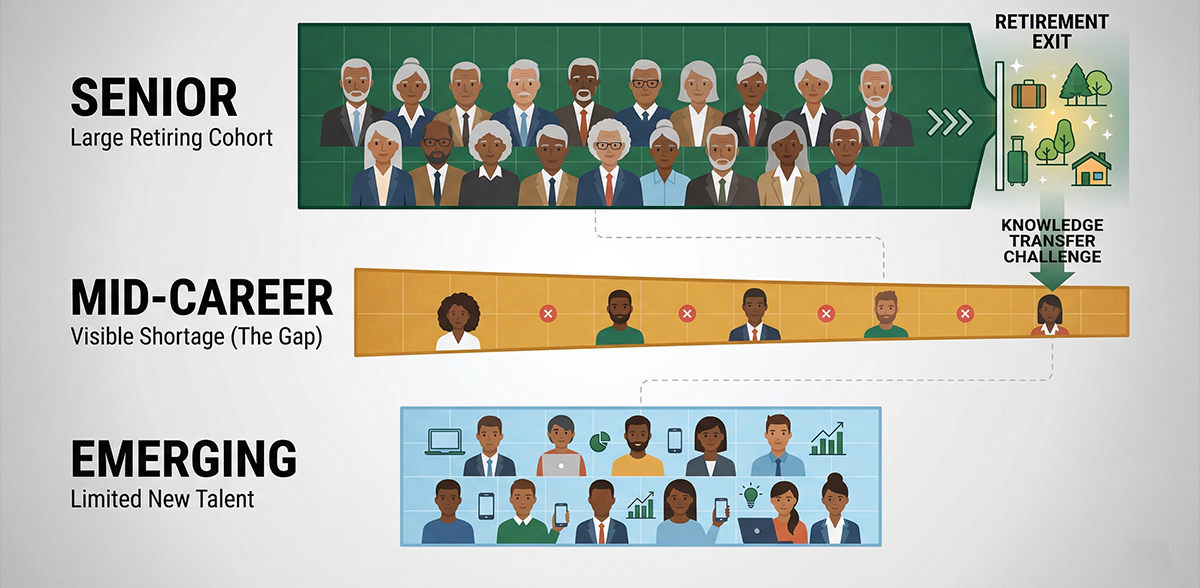
At the same time, the pipeline into the profession is slower. It takes over on average a decade+ to become licensed when education and experience are combined. Most data suggest a 5-7 year window post degree for licensure. So there is also this lag between knowledge leaving and knowledge replacing it. While there are many efforts being put into action to shorten the timeline for licensure, it is still an issue within the profession. It will take more efforts if the newly licensed professionals are ever to outpace the expected upcoming retirement pace.
Originally the apprenticeship model was in place to mitigate these conditions and allow the slower transfer of this knowledge. But that idea has all but disappeared. Yet, the medical profession has kept a model to a better extent than architecture and medicine may be able to manage their looming crisis better than architecture. Do we need to initiate residency programs, fellowship opportunities, and other structured learning environments and opportunities if we are to succeed and protect our knowledge moving forward? It is an interesting idea, but the financial aspects of this are quite the conundrum. So it is best left as a conversation for another time, but its food for thought.
Architecture is Knowledge Dense jump to 32:47

As we all well know, architecture depends both on technical and experiential knowledge. Technical knowledge is the side where we are continually learning over time. We need to keep up to date on things like codes, materials, regulations, software etc. etc. This is also all gained knowledge via easily transferrable methods. Much of the profession is geared around this type of knowledge in my opinion. Online courses, conferences, annual CEU requirements, etc. all are really focused on this type of consistent knowledge. Think about those HSW credits and what it takes to get one. That is almost exclusively set up to transfer technical knowledge. There is little to no nuance in this type of knowledge transfer. I might argue, from the perspective of this issue, that is the wrong type of knowledge we should prioritize in our annual learning.
So if we just look at the basic requirements for licensure. NCARB has been able to break this into its AXP and exam framework. The NCARB AXP has 6 Categories with 96 explicit tasks. These are the elements that have been deemed “essential” to become a licensed professional. Now they are transitioning to the Core Competencies, but that is framed into 16 topics with 54 subtopics tasks that compromise the required knowledge areas. These are considered “CORE” areas of knowledge. I might even say they are “the minimum” amount of knowledge required to do our work. We all know that being licensed is near the beginning of our architectural educational career path. I think these are also the goal of examination to earn licensure. More technical knowledge is tested than any experiential knowledge. There is even a kind of “saying”” that goes something like “if you wait too long to test, it will be harder because you know too much or the professional version of the content.” We continue to learn so much more after this milestone is reached, but it is all related to our particular focus in the profession and not “tested” upon any longer.
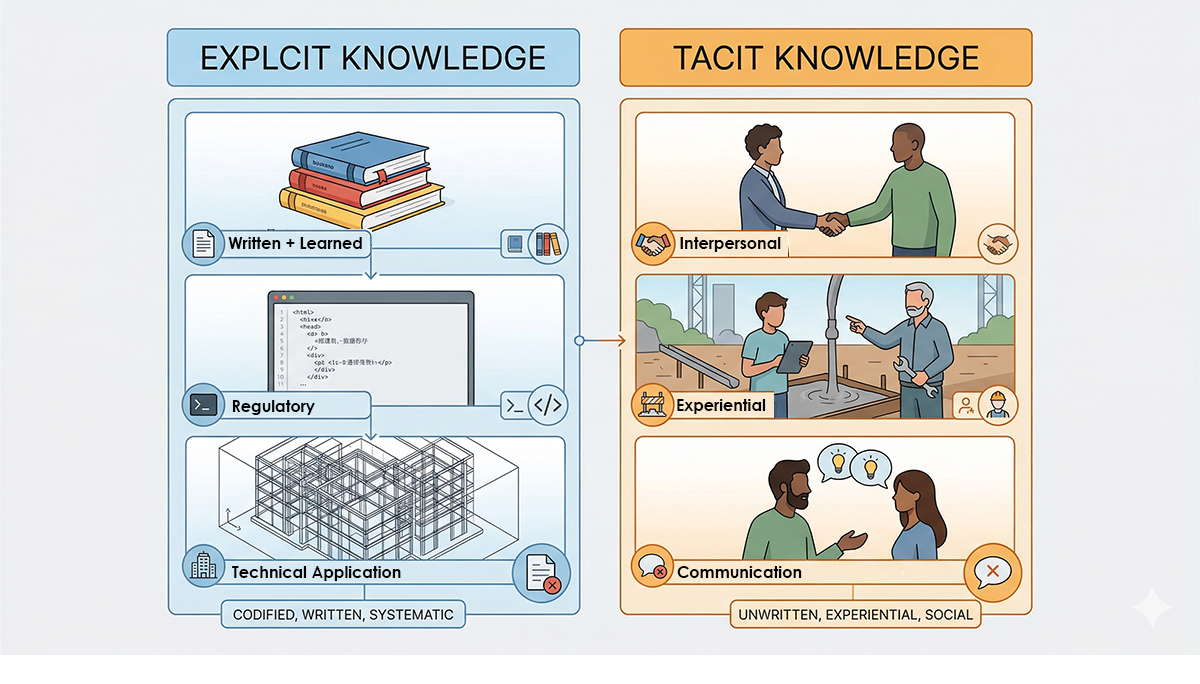
But we have a second set of knowledge that is bases solely on experience. One could say there it is heavily based on experience-based knowledge, including elements like construction sequencing, regulatory interpretation, consultant coordination, contract risks, client psychology, negotiation with contractors, project delivery strategies, and the list could go on and on. Most of these skills are not taught formally in school. They are learned through project exposure, mentorship, observation, mistakes, and most certainly time. That means much of the profession’s most valuable knowledge is experiential and empirical knowledge.
So even with this small summary, it is easy to see how we are a profession with a dense knowledge requirement. I would hold this in line with other professions of course, with some even being denser with knowledge especially technical knowledge; think doctors and lawyers. But we have another layer here which is the creative knowledge. This adds a different layer to the knowledge that we are required to possess and wield.
There is a philosopher named Michael Polanyi who spent his career studying what he called the limits of human knowledge. He wrote a book on the subject in 1966 and also pushed the ideas of “tacit” knowledge. He summarized several years of study with one very succinct statement that captures everything about this issue: “We can know more than we can tell.” That is the concern here. An enormous amount of what experienced architects know cannot be written down, cannot be put in a manual, and cannot be captured in software. It lives in their heads. And when they retire, it goes with them.’
Tacit knowledge: Personal, experiential, often inarticulable — even by its holder.
Another researcher, Donald Schön published The Reflective Practitioner in 1983 based on years of studying architecture studios at MIT with the support of the Royal Institute of British Architects (RIBA). His work showed that architecture specifically depends on ‘knowing-in-action’; a fluid and contextual judgment that resists reduction to procedure. When this knowledge leaves with a person, there is nothing to look it up in. It is gone.
Then in even more recent years, the EU commissioned a study tacit knowledge and wrapped up five years of funded research in 2023. This study brought together professionals and academics to study this issue of the transference of tacit knowledge specifically architecture. The website is here if you want to know more.
What Might Actually Be Lost jump to 48:26
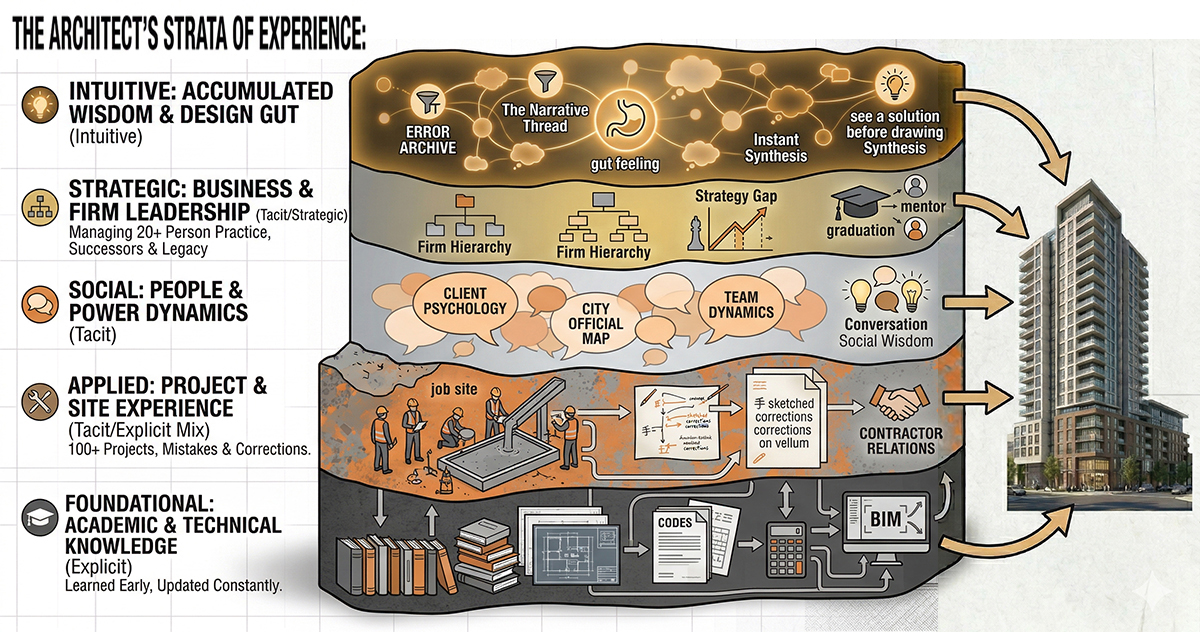
What exactly can disappear when experienced architects retire? It’s not just the technical knowledge. Well there is a great deal of tacit knowledge that could be lost forever. While you may argue that some of it would lose relevance over time and with age, think hand drafting tips, there is still much of it that is relevant. Some of the knowledge the profession risks losing is: (sorry for the bullet list)
- Professional Judgment
Knowing when rules can bend and when they cannot - Historical memory
Understanding why certain building and professional practices exist - Construction intuition
Recognizing problems before they appear in drawings
Learning from past mistakes and situations
Knowing what is happening ten steps from now and reacting to current issues with that knowledge - Client management
Handling difficult stakeholders and political environments
Soft skills for management of personal interactions based known tendencies - Professional culture
Standards of responsibility and ethics that are often transmitted informally though situational experiences and anecdotal conversations
While this is the shortest portion of the entire blog post, I would argue that it should be the longest. This list could go on for much longer, but you get the idea. Also, this doesn’t even begin to encompass our creative knowledge that is gleaned from years of trying and failing and iteration. All of the more subjective aspects of our profession that do not come solely from explicit knowledge but the synthesis of technical and creative, the expressed and the implied, the seen and unseen. So much of what we use on the daily in our profession is not just technical, but also from the “gut”. And that “gut” level knowledge comes from years of experience of ourselves and from those around us during all of those years. This is the area where the transference of that knowledge becomes at risk and possibly critical to the profession.
Ep 197: The Knowledge Gap
If you’ve made it this far, I don’t think it is necessary to beat the drum even more. It seems obvious that there is some validity to the concept. Architecture is easily understood as a system of both explicit (technical) and tacit (experiential) knowledge. I might even attribute this nature of the profession as to one of the reasons why it is so difficult to explain to the general public what we do and why it has value.
Yet, I am not certain whether I have convinced myself that this is a problem. Even if it is a looming concern in the profession, how critical is it? I would not say I have the answer. I think the real message here is that we should begin to think about this as aging professionals, younger professionals, and as a professional issue. No, we cannot create a system to institutionalize all of our tacit knowledge, but can we create opportunities to transfer this knowledge before we leave the profession. Can younger generations think of ways to pull this knowledge out of the older generation? Despite what the younger generations always think, and I mean throughout history, the older generation does have vast amounts of useful and relevant knowledge to pass along. I would argue is it not until you get older in age that you actually realize this. I know when I was young and emerging in the profession, I felt all the older folks had little to offer. But as I aged, I began to see those areas where they have so much to give.
So maybe the end result of this exploration is to simply imply and urge everyone to realize what is happening in the profession and to take steps to alleviate the possibilities of losing critical, tacit knowledge.
Cheers,

Special thanks to our sponsor Construction Specialties, maker of architectural building products designed to master the movement of buildings, people, and natural elements. Construction Specialties has been creating inspired solutions for a more “intelligently built” environment since 1948. Visit MasteringMovement.net to learn more.