
There are moments in practice when your job begins changing before anyone has formally admitted that your job has changed. The work you already have remains, but the expectations around it begin to expand, and suddenly the role starts asking for a different kind of judgment than the one that got you there in the first place. That shift can be valuable, but it can also be disorienting because responsibility often arrives before authority, clarity, or time have bothered to make an appearance. The result is a strange professional condition where you are still connected to the daily work but increasingly asked to understand and carry decisions that belong to the broader direction of the firm, and that is what we are here to discuss. Welcome to Episode 201: The Middle of Middle Management.
[Note: If you are reading this via email, click here to access the on-site audio player] Podcast: Embed Subscribe: Apple Podcasts | Spotify | Android | iHeartRadio | TuneIn

Today, Andrew and I are going to be talking about that special point in a career where people start trusting your judgement before they give you enough authority to act on it, otherwise known as middle management. This is one of those terms that sounds like it should be easy to understand, mostly because both words are familiar and neither of them appears threatening on its own. Middle management is generally the space between firm leadership and the people doing the daily work, but that definition barely gets us in the room. The real condition is more complicated: you are close enough to leadership to understand the pressure, close enough to the team to feel the friction, and often responsible for translating one side to the other without having full control over either. It is a strange professional condition, full of responsibility that expands faster than authority, expectations that are not always clearly stated, and the occasional realization that the real structure of a firm is often revealed by who carries the pressure, not who appears to be in charge.
Stuck in the Middle jump to 6:51

I have been in some version of middle management since 2003, which is either an impressive amount of professional seasoning or a sign that I should have asked better questions earlier. Either way, it means I have spent a large portion of my career occupying that strange place between the people setting the direction and the people trying to make that direction real. That is not meant as a complaint, at least not entirely, because there is value in being close to both sides of the equation. You begin to understand how leadership thinks about risk, money, staffing, clients, liability, growth, and the general circus act of keeping a firm pointed in roughly the same direction. At the same time, you remain close enough to the work to see how those decisions actually land on project teams, where strategy becomes deadlines, staffing plans become late nights, and abstract leadership conversations suddenly have names, faces, and calendar invites attached to them.
That proximity is probably the defining condition of the middle. You see more than you can always say, understand more than you can always fix, and absorb more than anyone would formally assign to your job description because writing it down would make the whole arrangement look suspicious. You become part translator, part pressure valve, part hallway diplomat, and part keeper of institutional memory, which sounds useful until you realize that usefulness and authority are not the same thing. The middle is where people often ask you to think like leadership before they have fully decided whether you are allowed to act like leadership. That gap matters, because it turns normal management into something far more complicated than simply coordinating people and projects.
That is where the fog starts to settle in. The middle is not difficult only because there is work above you and work below you, it is difficult because you can often see the connection between decisions and consequences before you are in a position to change either one. You understand why your leadership may hesitate, why teams may get frustrated, why clients may push, and why the clean answer rarely survives contact with the actual project. That kind of visibility can make you better, but it can also wear you down if the role stays undefined for too long. Middle management is not just the middle of the org chart. It is the middle of competing pressures, partial authority, and the uncomfortable realization that responsibility has a much easier time finding you than power does.
Authority Without Control jump to 23:12
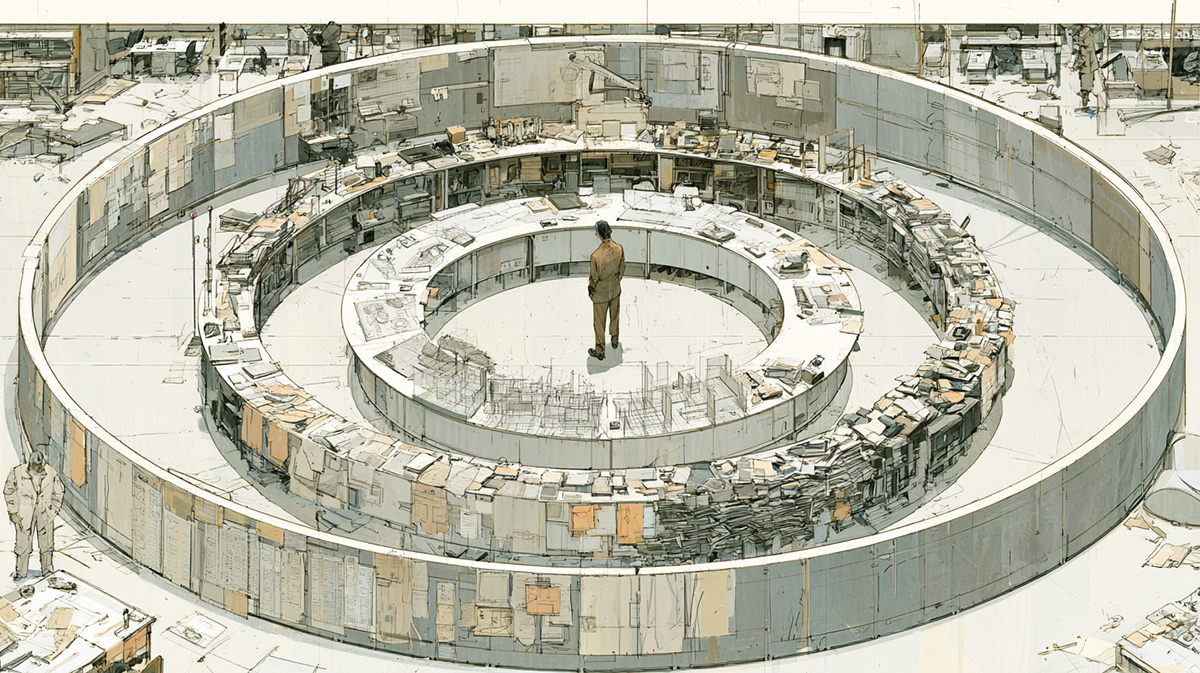
The hardest part of middle management is not simply that you are busy, because everyone in an architecture firm is busy. As a collective industry, we tend to treat being busy that like a personality trait rather than a scheduling failure. The harder part is that middle management often assigns you with responsibility that exceeds your authority. You are responsible for the performance of the team, the quality of the work, the mood in the room, the client’s confidence, the consultant coordination, the schedule, and the general sense that the project is not slowly sliding into a ditch. Yet many of the decisions that shape those outcomes may sit above you, outside you, or in some cloudy zone where everyone has an opinion but nobody appears to own the consequences.
The other part that rarely gets acknowledged cleanly is that middle management does not usually replace the work you were already doing. It gets added to it. You still have the day-to-day project responsibilities, the team questions, deadlines, drawing reviews, client calls, and the general obligation to make sure the actual work gets done. Then the role begins to expand sideways. You are asked to mentor, recruit, interview, review staff, help with standards, support internal initiatives, participate in firm planning, manage culture, contribute to proposals, show up for business development, and somehow become more visible in the marketplace without becoming less available to the projects already consuming your calendar. Nobody announces that the day has been expanded to 27 hours, but the expectation seems to arrive anyway.
That mismatch is where the role starts to grind. You may be asked to lead a team, but not always given the authority to change the team. You may be expected to maintain morale, but not always included in decisions that affect morale. You may be responsible for communicating leadership’s direction, even when that direction is still soft around the edges and held together with optimism and meeting notes. This is especially true in firms going through transition, because transition has a way of creating expectations before it creates structure. People may be asked to think like future leaders, behave like future owners, and carry the emotional investment of long-term stewardship before the actual terms of that future are clear. That is a difficult place to stand for very long because ambiguity is not neutral. It has weight.
The danger is that middle managers can become the place where unresolved leadership issues get temporarily stored. They absorb confusion from above and frustration from below, then try to turn both into something useful before the next staffing meeting. That can make the role feel strangely invisible. When things go well, the machine appears to be functioning naturally. When things go poorly, the person in the middle is often close enough to the problem to receive the heat, but not always empowered enough to have prevented the fire. This is where resentment can start to form if people are not careful, because being useful without being fully trusted, included, or empowered is not a sustainable leadership model. It may work for a while, but so does putting a bucket under a leaking roof.
The Necessary Apprenticeship jump to 38:36

This is where the episode turns from complaint to value. Middle management becomes valuable because it forces you to understand both the daily work and the leadership decisions that shape it, often before you have the time, authority, or emotional bandwidth to do both effectively. That does not mean you are incapable of carrying the work. Most people who end up in the middle are there because they have already shown they can handle a lot of responsibility. The problem is that capability is not infinite, and being able to do one hundred things well does not mean you can do all one hundred of them well at the same time. At some point, the role stops being about whether you are competent enough and starts being about whether the expectations around the role have been defined honestly enough. You are still firmly attached to the daily work, but now you are being asked to understand, interpret, and sometimes carry the concerns of leadership before you have fully moved into that role. That is not always comfortable, but it can be useful, assuming the process is actually preparing you for something and not just adding another layer of responsibility because the organization found a reliable person and quietly mistook capacity for availability.
This is also where you start learning the difference between having an opinion and carrying a consequence. Earlier in your career, it can be easy to see the obvious answer because you are usually looking at one portion of the problem. Middle management makes that harder because the view gets wider whether you asked for it or not. You start to understand why staffing decisions are complicated, why client relationships require more patience than seems medically advisable, why a technically correct answer can still be poorly timed, and why the cleanest solution may create problems somewhere else in the firm. That does not mean you stop having opinions. It means you begin to understand what those opinions cost once they become decisions.
The value of this apprenticeship is that it should create memory. You remember what unclear authority felt like. You remember how vague expectations affected motivation. You remember how much extra work got carried by people whose titles did not fully reflect their responsibility. You remember the difference between being trusted with outcomes and being trusted with actual decision-making. Those memories should matter later because they become part of your leadership filter. Once you move beyond the middle, the goal is not to finally gain enough authority to recreate the same fog for the next group of people. The goal is to remember what the fog felt like and make different choices when you have the ability to clear some of it.
Remembering the Fog jump to 46:22

The hope is that once you move out of middle management, the lessons come with you. You remember what it felt like to be handed responsibility without enough authority. You remember how vague expectations affected your confidence, your energy, and your ability to make good decisions. You remember what it was like to carry the daily work while also being asked to think about staffing, culture, mentoring, business development, client relationships, and firm strategy, usually with no magical expansion of the day and no formal reduction in the work already sitting on your desk. That memory should make you a better leader because it gives you a sharper sense of how decisions actually land on people.
The other side of that, and I think this matters, is that ownership should not become the easy villain in this conversation. Final authority carries real weight. When you are accountable for the final decision, you are not just deciding what feels fair in the moment or what would make one team’s life easier this week. You are weighing risk, payroll, reputation, client relationships, long-term stability, and the livelihood of the entire office, which is a sentence that sounds dramatic until you are the person who actually has to make the call. That does not excuse poor communication, vague expectations, or delayed decisions, but it does explain why leadership can look different once the consequences are fully yours to carry. Middle management should teach you how decisions land on people. Leadership teaches you what it means when those decisions cannot be passed any higher.
That is the danger in clearing the fog. Once you are no longer standing in the middle of it, the memory can soften. The constraints of leadership become more visible, the reasons behind old decisions become easier to understand, and the frustrations you once felt can start to look less urgent from a different seat. Some of that is maturity. Some of it is perspective. Some of it is also convenient amnesia wearing a decent jacket. The risk is that people finally gain authority and then use it to preserve the same ambiguity they once found exhausting. They forget how silence felt from below. They forget that unclear authority does not feel neutral to the people carrying the work. They forget that asking someone to be patient without giving them structure is not leadership development. It is just delay with better stationery.
The value of middle management, if there is going to be value, is that it should make leadership more humane and more honest. Not softer. Not easier. Just clearer. You should come out of the middle with a better understanding of how responsibility, authority, time, and trust have to line up if people are going to do good work without slowly turning into furniture. You should also come out of it with enough humility to recognize that final authority is not just permission to do what you always thought should be done. It is responsibility with consequences attached. The goal is not to escape middle management and then congratulate yourself from higher ground. The goal is to remember the fog clearly enough that, when you finally have more control over the conditions, you do not become the person quietly pumping it back into the room.
Ep 201: The Middle of Middle Management
Middle management is not usually the part of a career anyone dreams about, which is probably fair since most dreams do not involve inheriting more responsibility while time and authority stand nearby pretending they were not invited. Still, there is something important that happens in that space if you are paying attention. You start to see how decisions move through a firm, how unclear expectations become someone else’s burden, and how much leadership depends on remembering what pressure felt like before you had the ability to pass it along. The middle can make you sharper, more patient, and more useful, but only if it does not teach you the wrong lesson along the way. The goal is not to survive it just long enough to recreate the same fog for the next group of people. The goal is to come out of it with enough memory, humility, and judgment to make the middle a little less mysterious for whoever comes next.
Good luck,

Special thanks to our sponsor Construction Specialties, maker of architectural building products designed to master the movement of buildings, people, and natural elements. Construction Specialties has been creating inspired solutions for a more “intelligently built” environment since 1948. Visit MasteringMovement.net to learn more.