
Being an architect isn’t as glamorous as you might think – at least not all the time. I generally work on single family residences and most of these houses are modern in style. During a typical day I spend a fair amount of my time designing – and coordinating those designs – so I think I have it pretty good. Part of the reason I think I have found happiness in my chosen profession, despite being pounded with emails from people who think being an architect is currently a terrible idea, is the attitude I bring towards my job. Not everything I do is big picture design – compared with the overall time spent, very little is – but I consider coordinating a project and the details of the construction of that project integral to a successful design.

There are many things I do during a typical day – designing “stuff” is just one very small portion – but I still consider myself a designer more so than a project architect. Since I work at a smallish firm, everyone wears many hats and nobody has just one task or label. To be considered a designer just means you need to think about the design of everything – and I mean everything. I have said on many occasions that it is the little things that matter in modern design so despite the fact that I spent the first part of my morning coordinating the fire sprinkler heads, all the penetrations in the ceiling plane will align, that is still designing. That might not sound like much but there is a lot going on in the ceiling – light fixtures, sprinkler heads, air supply and return grills, security sensors, audio speakers – and it all has to be coordinated with where the air-conditioning ducts are running, while missing all the structural beams. I design details as well as buildings.

I did a walk-through on the site today just to document progress and thought I would use the bridge in the project as an example of what I am talking about. Let’s start with the site photos:

.
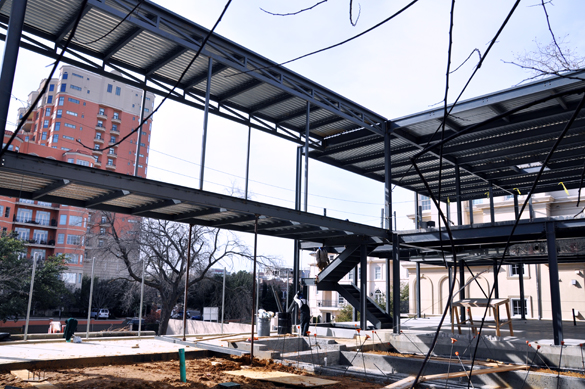
Bridge view from Ground Floor Level

From this angle, we are looking up at the bridge connecting the building at the front of the lot to the building at the rear of the lot. The stage of construction at this point is that most of the steel structure is in place and the contractor is pouring floor slabs. The steel for the bridge went up last week and the metal fabricators are on site installing the stairs. I am standing in what will be the interior courtyard of the building and the side of the bridge facing me is almost entirely glass – from the floor to a height of 10′-0″ and the span is 40′ between the two building masses.

.
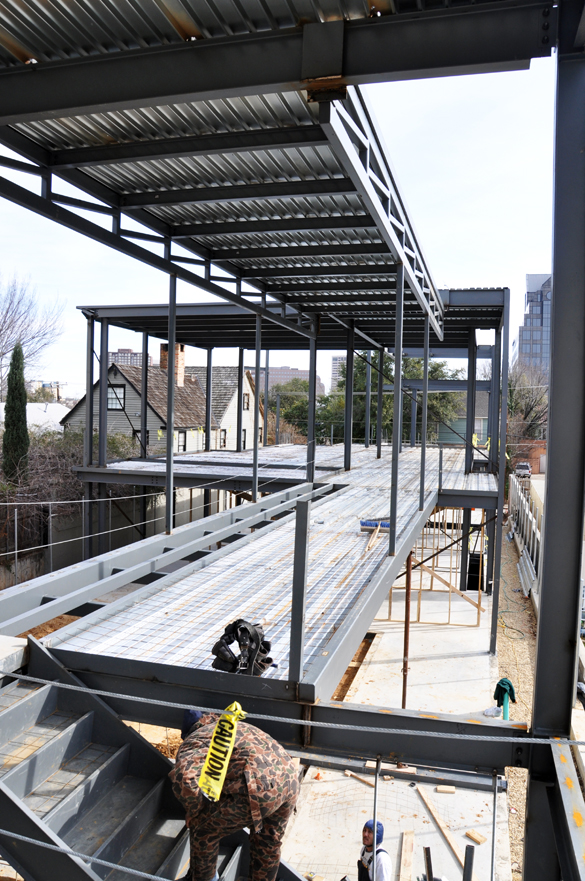
Bridge View from Upper Level Stairwell

This is a view from the upper level looking down the bridge. That is one of the steel-workers if you are wondering what that camouflaged blob is at the bottom of the picture. To minimize the visual weight of the bridge, we brought the glass down to the floor and we are running all the mechanical and electrical in the ceiling above. This allowed us to reduce the depth of the floor to just about 16″ – which won’t look like much for a 40′ span.

.
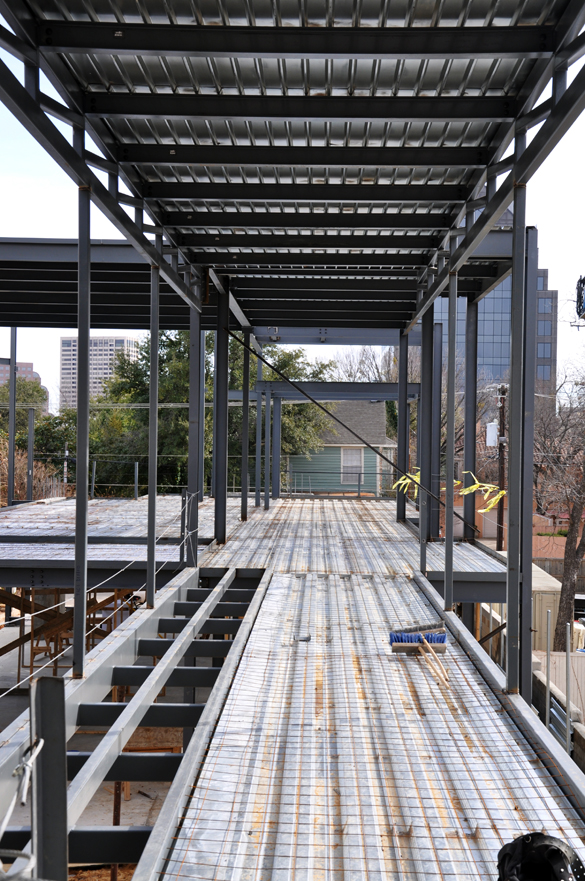
View Down Bridge Space

This is an important shot to convey the intent of today’s post. On the right hand side you can see the metal decking and welded wire mesh where concrete will be poured for the floor of the bridge. The repeating rectangular spaces on the left will remain visually open – we are installing a glass floor along the length of the bridge. The steel members will actually become the support for the individual pieces of glass – which do have size limitations. This is how we determined the spacing of the structure … based on the glass limitations. The joints in the floor between the individual pieces of glass will also align with the glass that will be in the wall.

.
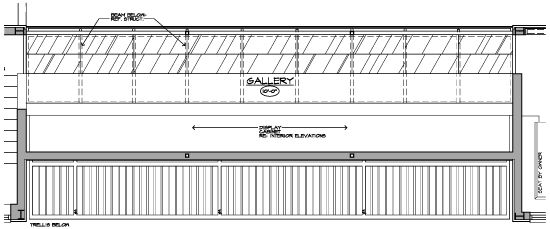
Partial Bridge Floor Plan

.

Building/ Wall Section at Bridge

I know that not everyone reads construction drawings so if you don’t I apologize in advance. I included this partial construction detail to help show the relationship between the floor (both the glass and concrete portions) to the overall bridge shape.

.

Bridge Glass Detail

Here is a enlarged look at the corner of the bridge walkway where the glass floor and the glass wall come together. The arrangement and sizing of the structural steel was worked and re-worked until we got it to this point. There is enough of an offset with the steel beam so that the glass at the floor has a place to set. We also sized the vertical columns that connect the structure at the floor to the truss structure at the ceiling with 2″x3″ tube steel so that the width of the members could be enclosed within the metal of the window system. When this bridge is finished, you won’t see any of the columns in the glass wall.

So maybe it isn’t apparent but the point I am trying to make is that the design idea for this bridge took very little time to develop when compared to the development and coordination of the construction details. There is a lot going on but none of that should come across in the finished product – not if I’ve designed it well. So many phone calls … from the glazing vendor to talk about glass spans, to the structural engineer to convey my ideas on how this bridge should be framed, to the zinc manufacturer to coordinate how we wrap it in the zinc metal siding (did I mention that the zinc is black?) so that the material breathes properly. It all comes together and with the combination of design ability and construction knowledge of how things actually get built …

how could you do this and not consider yourself a designer?

.

People don’t always understand what we do or why we do it – and for the most part I am okay with that. I am the expert and that’s why they have hired me … so they don’t have to know about everything that’s involved. Their appreciation when it’s done tells me that I did what I was supposed to do.

(if you are unable to pick your way through the drawings, here is a 3d animation  we made during the schematic design phase. The project has obviously developed since the creation of the video, but at least it paints a picture)


YouTube Channel: Life of an Architect - Sale Street Schematic

.

.

kinda - sorta related posts:

  • John

    Bob, I take some issue with the wording you have chosen here. What you are describing is what it means to be an architect, not just a designer. There is no responsibility, or accountability, to call yourself a designer. Anyone can do it, take everyone on TLC, for example.

    In addition to all the schooling and commitment and testing etc. that you have described nicely in other posts, being an architect involves more than just floor plans and pretty renderings. It’s all about how the project functions and coordinating whole groups of people to that end, including all the phone calls (and meetings) you mentioned.

    Ultimately, I agree 100% with your intent. Architects “design,” and that design should be carried all the way through the project from schematics to details to specifications and so on. What we as architects should be doing is educating people on what architects actually do for clients and a project, which you have illustrated well. I just don’t think we should add any more credence to the term “designer” when being an architect involves so much already.

  • http://www.lifeofanarchitect.com Bob Borson

    Hi John,

    Point taken – what you are saying so expeditiously is what the point of my post was supposed to convey. Originally I was going to title this the same as the other posts in this series – Do you want to be an Architect: Designers.

    So many young people think that being a designer is just about the imagery of the building and think that if all they are working on construction drawings they aren’t getting to participate in the design process. If I had spent a little more time on this post, I think that I would have worked it in a way that clarified the process more than the label.

    Thanks for taking the time to set that straight and leave a comment.

  • http://twitter.com/DESIGNSTUDIO26 DS26

    i really like the project. nice.

  • http://twitter.com/Splintergirl Amy Good

    Nice project…like the exterior spaces and the fact that some can be very private. It’s screaming for a timber pergola, though *wink wink*. I understand what you mean about the details…bet you’ll be pleased to see the end result.

  • http://twitter.com/mondo_tiki_man Jonathan Brown

    It’s the classic dichotomy in architecture, designer or manager, and the truth you’re showing is that you can’t have one without the other. Many offices have the “design side” and the “production side” and there is little maneuvering between. Our firm has actually been guilty of the diametric opposite, trying to consider no one as either specifically designer or manager and in reality, this doesn’t work either. Each architect has specific strengths in their game, and those should be exploited appropriately. What we have found to be the most effective (and is our current model) is a co-management model, with a Design Manger [DM] and a Project Manager [PM] assigned to each project. The model has the DM with 90% involvement starting in SD, and the PM with about 10%, this then transitions through the project such that the involvement is just the reverse in CA. We’ve found it is an excellent way to keep QC up in the projects, our best managers and our best designers fighting for the project from their distinct points of view through its life. This way, the projects are managed well, and there is as little of the original design concept lost as is possible. It also allows each side to be involved in the alternate facet of their roles so no one become too one-dimensional as a professional. Added benefits are that there are two primary contacts through the process, so if one isn’t available, the client or contractor doesn’t miss a beat in contacting the other. We always felt there was a bit of a schism transitioning from “design” to “production” as one team hands off to another, but with this model, both teams stay involved through the whole process.

  • http://www.lifeofanarchitect.com Bob Borson

    Jonathan,

    That’s a great comment and you hit on what I was saying but you turned it up to 11! Well done …

    Since our office is small, in some capacities the divide is chasm-like which makes the process frustrating at times but you can’t expect people to work outside of their strengths and expect consistent results. Just like in every other aspect of my life, I am an anomaly because I truly do move between the two sides (jack of all trades). Your description of the DM and PM is smart, the trick is to try and get the PM’s to be more like DM’s and vice-versa.

  • http://www.lifeofanarchitect.com Bob Borson

    No question that I am excited to be working on a project like this … it’s why I think I am in the greatest profession there is (now if I can only convince everyone else)

  • http://twitter.com/mondo_tiki_man Jonathan Brown

    Absolutely, and I think inherently very few people really want to completely let go of design or in the obverse, let go of some management of the documentation and construction process.

    That truly is the fun part of being at a small firm, having opportunities (and often the necessity) to do so many different things and be involved in so many facets of the profession. My first firm had 11 people, and it was great because anything I wanted to try my hand at was open to me at some level. My second job came at a local international firm with 150+ employees in the Dallas branch and while their exposure allows one to work on variety of projects in a diversity of exotic locations, one’s role is very narrow.

    The last 9 years I’ve split the different at a mid-size firm, and even here (25+ employees) there are a lot of opportunities. For example, in addition to being one of 3 lead designers, I coordinate our digital design, managing the use of Sketchup by the design staff, the Adobe Suite for design presentations, Cumulus for our 8,500+ asset image library & our 450+ asset unit plan library, as well as portions of our marketing, web sites, and social media profile.

    Smaller firms can sometimes employ staff to do these ancillary functions, but if you are less than 30, having a secretary, HR/business operations, IT, and accountant (typical) it’s hard to also absorb the overhead of a CAD manager, marketing person or other aspect that can simply become an extra-dimension of the duties of existing staff. Personally, I really enjoy being able to contribute in multiple ways.

  • http://twitter.com/mondo_tiki_man Jonathan Brown

    Walking your project does make all the angst go away for a while. Gives you a tangible realization of your efforts.

  • http://www.lifeasanexperiment.com James D. Burrell II

    While reading the Fountainhead, I questioned why I didn’t study engineering and choose a career in architecture. Then I finished the book and went on living not being an architect. Your post rekindles that small desire. I absolutely love to watch structures develop from concept to reality. It’s truly an amazing art. Thanks for the inside look, Bob.

  • Anonymous

    Bob…great post and the house looks great. I agree with previous comments that you are an architect…as I am. I never say that with arrogance but with great pride and humility. BTW, send me one of these houses to design…

  • http://www.lifeofanarchitect.com Bob Borson

    Thanks James.

    Since this project will be under construction for another 18 months, you will probably get to watch the entire process if you stick around. You can live vicariously through me if you want (I’ll try and step it up a little)

    Thanks for taking the time to comment

  • http://www.lifeofanarchitect.com Bob Borson

    Ha! Sure, I have houses like these just piled up outside my office door …

    This is an important project for me because it will move me up in a class of buildings. There always seems to be milestones that one clears which allow for better opportunities down the road – this is that type of project.

    I am going to enjoy this process as much as I can.

    Thanks -

  • Pingback: Creativity & finding the right people for your project | The HTRC: Homeowner's & Trades Resource Center

  • JT

    You can enjoy architecture even if you’re not an engineer or an architect just as a n architect would appreciate architecture when he’s out of work and unemployed ;)

  • JT

    I got scared of the details but the more I scrolled up down back and forth to co-ordinate the photos with the details, I loved it :)

  • JT

    Oh God Thank you Bob & John,

    i went and did another 2 year course on building technology and drafting after my bachelor’s degree in Architecture from RMIT Melbourne just so that I can learn about construction and drafting working drawings.

    Some architects ask me why. but now I know it wasn’t in vain :)

  • http://www.lifeofanarchitect.com Bob Borson

    JT -

    Cheers to that, soak up some of that good Australia sun for me

  • Petra Schwarczova

    Hello Bob.
    I just read few articles at your blog and I must say I love it. It’s so inspirational. I am a first year Architectural technology student in England (originally from Slovakia) and I can see I will visit your blog very often from now on. :)
    Thanks for good tips for students. And practice too.

  • http://www.lifeofanarchitect.com Bob Borson

    Welcome Petra and thanks for chiming in! (we love comments on this site)

    Happy 2012 and have a good year in school

  • Rene

    Bob-
    Thank you. For those that missed the subtle idea that Architects are designers…could you address the HGTV notion that you need to hire a “Designer”. I have been asked by clients in Interviews…”at what point should we engage a designer?” I then explain. I guess my complaint is that the AIA and Architects have allowed the rest of the world to Steal the cool part of being an architect away from us. As you mentioned there is the idea …but is the hours of detailing and coordinating that make the design fabulous! I tell clients and future client that if they are wondering if an Architect was used or someone is a great Architect look at where different materials come together. The details tell it all!

  • http://www.lifeofanarchitect.com Bob Borson

    that might be a good idea for a post – I need to think on it and see if I can get some inspiration or direction.

    Thanks for adding your comment to the conversation – I appreciate it.

  • Ar Khushboo Agarwal

    Hey Bob..its always great reading your blog!! Every time I read, I say yes..yes… exactly my feelings…. I am from India and I really want to work with you at-least for few months!! :)