
Most firms would say they value loyalty, and most employees would probably say they do too, which makes it interesting that both sides seem increasingly unsure what the word actually requires. Firms want people who are invested for the long term, while employees have become more careful about giving that commitment away before they understand what comes back in return. Somewhere along the way, what used to feel like a shared understanding started to look a lot more like a negotiation. Welcome to Episode 210: The Cost of Loyalty
[Note: If you are reading this via email, click here to access the on-site audio player] Podcast: Embed Subscribe: Apple Podcasts | Spotify | Android | iHeartRadio | TuneIn

today we are going to be talking about loyalty, specifically the kind that firms tend to expect from employees and the kind employees used to assume they would get back in return. For a long time, that relationship also shaped much of what we thought of as firm culture, because people stayed long enough to build trust, shared history, and a sense that they were part of something that extended beyond the project in front of them. Very little of that had to be designed intentionally because the conditions of working together were already doing most of the work. Once those conditions changed, it became much easier to see that culture and loyalty had been reinforcing one another in ways we had mostly taken for granted.
The part I find interesting is that I don’t think this is really a story about employees becoming less loyal, even though that is usually the easiest explanation to reach for. A more useful question is whether people are simply responding to a relationship that has become more clearly transactional, and whether firms have adjusted their expectations as quickly as employees have adjusted their behavior. That gets us into retention, compensation, professional growth, and leadership. However, the larger question is really about culture and what it takes to create genuine investment when the old assumptions are no longer doing the work for us. Loyalty is still possible, but I think firms now have to be much more deliberate about creating the conditions that make loyalty worth giving.
What Culture Used to Run On jump to 5:55
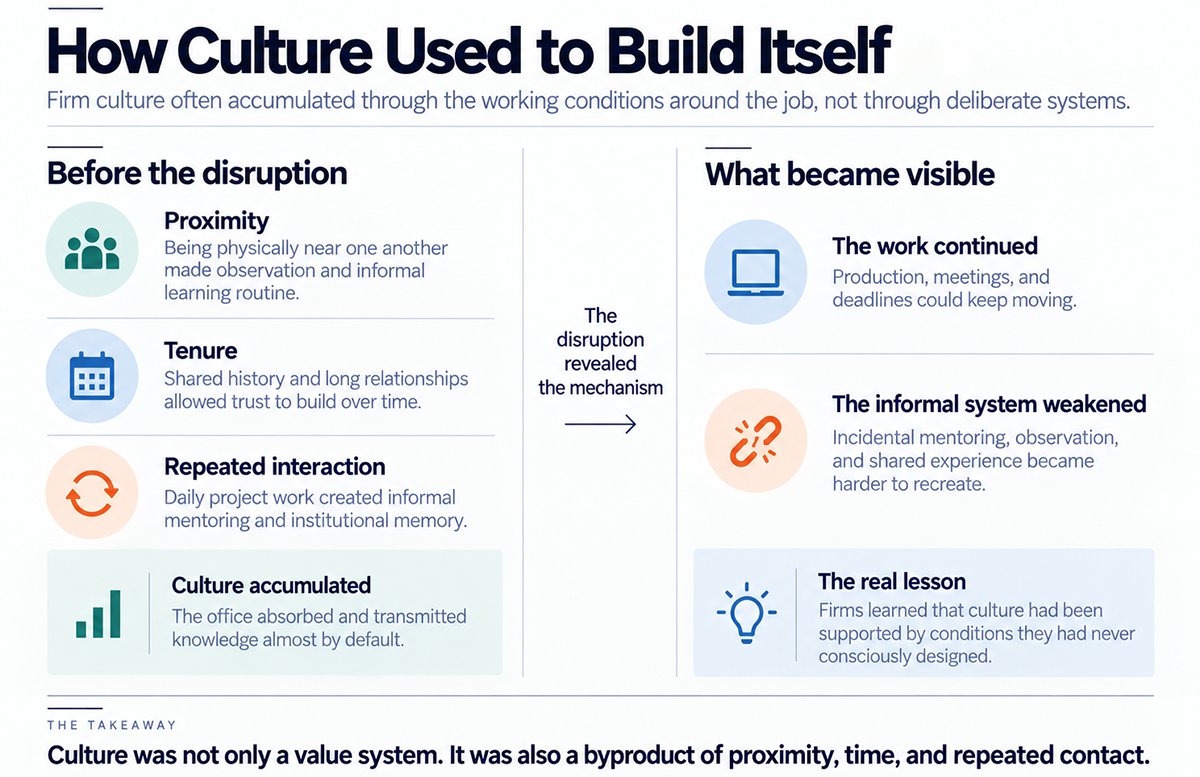
For the vast majority of my career, firm culture was something experienced long before anyone thought to describe it as a management responsibility. Every office clearly had its own personality, but most of that personality developed while everyone was busy doing the actual work rather than through any deliberate effort to create it. A younger architect could hear a more senior architect work through a difficult consultant call or watch how someone more experienced handled a client meeting, and some part of that knowledge transferred simply because they happened to be there. The same thing happened with trust as people stayed around long enough to learn who could be counted on when a project became difficult and who understood some obscure part of the work because they had already dealt with it before. Shared history was accumulated, and eventually all of those relationships began to feel like something the firm had created, even though the conditions of working together had actually been doing much of the work for us.
COVID exposed how dependent that version of culture had been on conditions nobody had thought very hard about. Firms discovered fairly quickly that the work itself could continue from somewhere else, although many of the interactions surrounding the work did not transfer nearly as well because they had never needed to be scheduled or even acknowledged before. A conversation that once happened at somebody’s desk moved inside a private meeting, which meant the person who might have learned something simply by being nearby was no longer part of it. The answer is not as simple as putting everyone back in the office and assuming the old culture will reappear, because proximity was never the culture itself; it was one of the conditions that allowed relationships to develop without anyone having to deliberately manufacture them. The more important realization was that firms had been relying on a set of circumstances they had never consciously designed, which also meant they had never learned how to replace those circumstances once they changed.
This was the post I talked about in this section where we discussed how “goal-oriented” employees seem to have all turned into “task-oriented” employees.
How the Deal Changed jump to 21:48
The old employment relationship depended on more than mutual loyalty; it also depended on both sides being willing to take some risk on the other. Employees were often expected to begin operating at a higher level before the title and compensation formally arrived, while firms were expected to recognize that growth once it had been demonstrated and reward it within a reasonable amount of time. That sequence made sense because there is no perfect way to know whether someone is ready for greater responsibility until they begin carrying some of it, just as there is no guarantee for the employee that stepping forward will immediately produce a raise or promotion. The arrangement worked when both sides trusted that the temporary imbalance would eventually correct itself. There is an important difference between asking someone to prove they can perform at the next level and allowing them to do that job indefinitely without recognition, which is where a development opportunity turns into exploitation. Still, some amount of investment before certainty has always been part of professional growth, and removing that uncertainty completely is difficult because somebody has to move first.
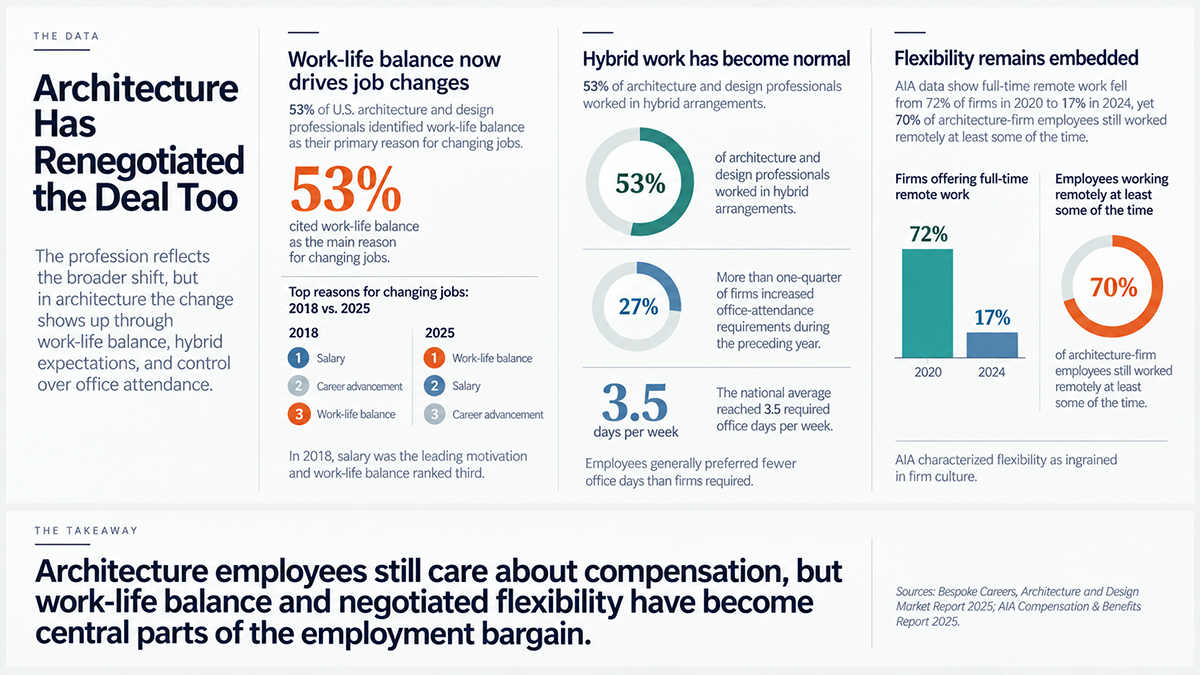
The employment relationship becomes more complicated when both sides start protecting themselves from making that first investment. Firms have become more cautious about advancing people before they have demonstrated that they can handle the responsibility, while employees can be understandably reluctant to accept additional responsibility before knowing exactly what they will receive in return. Compensation becomes unusually powerful in that environment because it is the easiest part of the relationship to measure. A larger salary offer does not require anyone to interpret whether there is meaningful mentorship, whether the next project will create better experience, or whether remaining in the current firm might lead to a larger role two years from now; the number is sitting there in front of you, and the comparison takes almost no effort. A higher salary may absolutely be the right reason to leave, particularly when someone is being underpaid, although it is not automatically the better career decision simply because it is the clearest one. The less visible parts of professional growth are harder to value, which means firms have some responsibility to make those opportunities easier to see before expecting employees to treat them as part of the reason to stay.
The loyalty problem starts to look different once responsibility for career growth is placed on both sides of the relationship. A firm cannot expect someone to remain invested simply because opportunities might eventually appear, and an employee cannot reasonably expect every increase in responsibility to be compensated before there has been any opportunity to demonstrate the capability that justifies it. Leadership must make the path visible enough that employees understand what the next level requires and where they are being given a chance to prove themselves, while employees have to decide whether they are willing to step into those opportunities before every outcome has been guaranteed. Treating every stretch assignment as unpaid labor makes development nearly impossible, while treating every promise of future advancement as something employees should patiently trust creates exactly the kind of skepticism we have been talking about. The changed deal may therefore be less about one side becoming disloyal than about both sides becoming more reluctant to invest without certainty, even though meaningful career growth still requires some period where neither party knows exactly how the bet will turn out.
What Research Actually Says jump to 39:10
Compensation remains an important part of that decision, although current research makes it difficult to treat money as a complete explanation for either satisfaction or commitment. Pew Research Center found that only 30 percent of U.S. workers were highly satisfied with their pay in 2024, while an even smaller 26 percent were highly satisfied with their opportunities for promotion. Satisfaction with training and skill-development opportunities had also fallen from 44 percent in 2023 to 37 percent in 2024, which suggests employees are evaluating not only what their job is worth today but whether staying there is likely to make them more valuable tomorrow. Workers who were dissatisfied with their compensation also tended to describe the problem in terms of fairness, with 71 percent saying their pay was too low for the quality of their work and 70 percent saying it was too low for the amount of work they performed. Compensation clearly matters, but those responses make the issue look less like an endless appetite for higher salaries and more like an ongoing evaluation of whether the exchange between contribution and reward still feels reasonable.
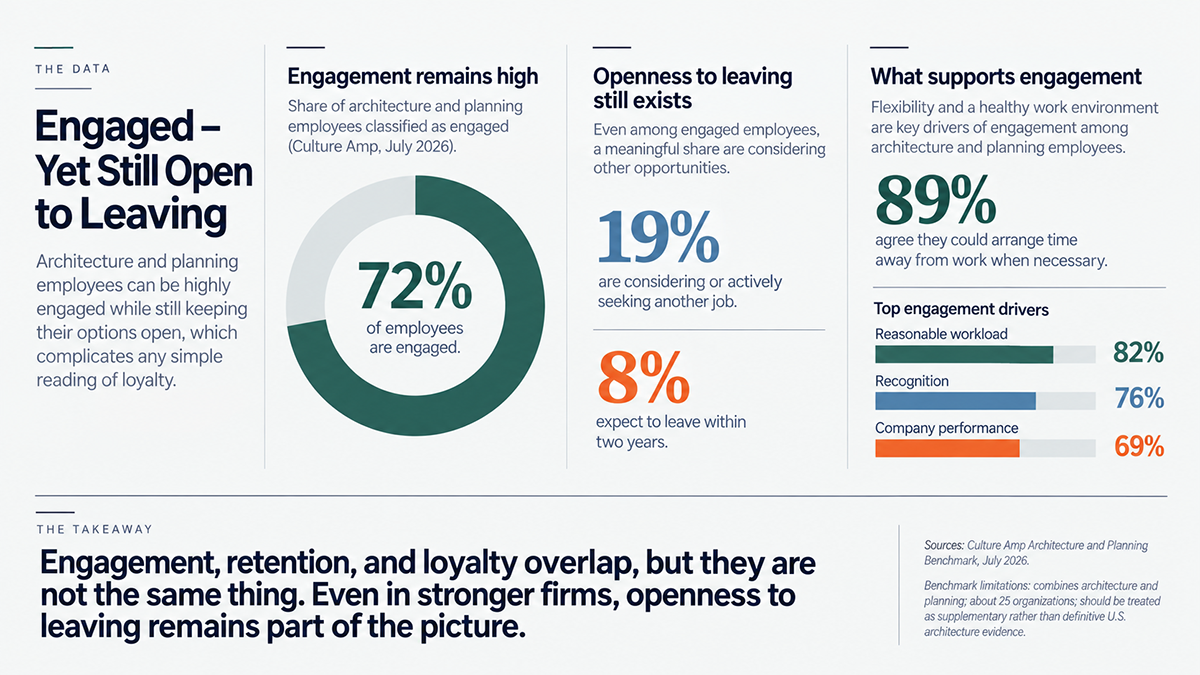
Career development appears even more consistently in the research when the question shifts from satisfaction to why people actually leave. Work Institute’s 2026 Retention Report found that career-related concerns accounted for 19.2 percent of employee departures in 2025 and remained the leading reason employees left their organizations for the fifteenth consecutive year. The underlying career concerns are also changing in ways that matter to this conversation, with promotion-related departures up 118 percent since 2022 and job-security concerns doubling from the previous year to their highest level since 2020. Those numbers make simple retention much less reassuring because an employee remaining in place does not necessarily mean the employee sees a future there; a cautious labor market can keep people from leaving while doing almost nothing to increase their commitment. A firm can therefore have relatively stable headcount while still carrying a meaningful amount of career dissatisfaction underneath it, which makes development part of the employment bargain rather than an optional benefit added after everything else has been handled.
Employee engagement provides the clearest distinction between people who remain employed and people who are actually invested in where they work. Gallup’s 2026 State of the Global Workplace data show that only 31 percent of employees in the United States and Canada were engaged in 2025, while 52 percent were not engaged and another 17 percent were actively disengaged, meaning the large majority were still employed without demonstrating the level of involvement firms usually imagine when they talk about loyalty. Gallup’s manager research adds another layer by finding that managers account for at least 70 percent of the variation in team-level engagement, which places an enormous amount of influence on the everyday experience of working for someone rather than on broad statements about organizational culture. Gallup and Workhuman also found that well-recognized employees were 45 percent less likely to have changed organizations two years later, while employees receiving stronger recognition were 65 percent less likely to be actively looking or watching for another job. Taken together, the research does not diminish the importance of competitive pay; it shows that pay helps establish whether the relationship feels fair, while management, growth, and recognition have much more to do with whether someone decides the relationship deserves deeper investment.
The Fix jump to 53:48
Rebuilding the relationship starts with making the path forward visible, because employees cannot place much value on opportunities they do not recognize or understand. Transparency still matters, although I think it needs to mean more than explaining what is happening inside the firm when business conditions change. Leadership also has to be clearer about what professional advancement actually looks like, what someone needs to demonstrate to move into a larger role, and where the opportunities exist to begin proving that capability. A firm may believe it is giving someone tremendous opportunity by bringing them into a client relationship or allowing them to take ownership of a more complicated part of a project, while the employee may simply experience the same moment as being asked to do more work. That difference in perception is important because the firm cannot assume people will automatically understand the developmental value of every opportunity placed in front of them. Making the connection explicit does not cheapen the opportunity; it gives the employee enough information to decide whether they are willing to invest in it.
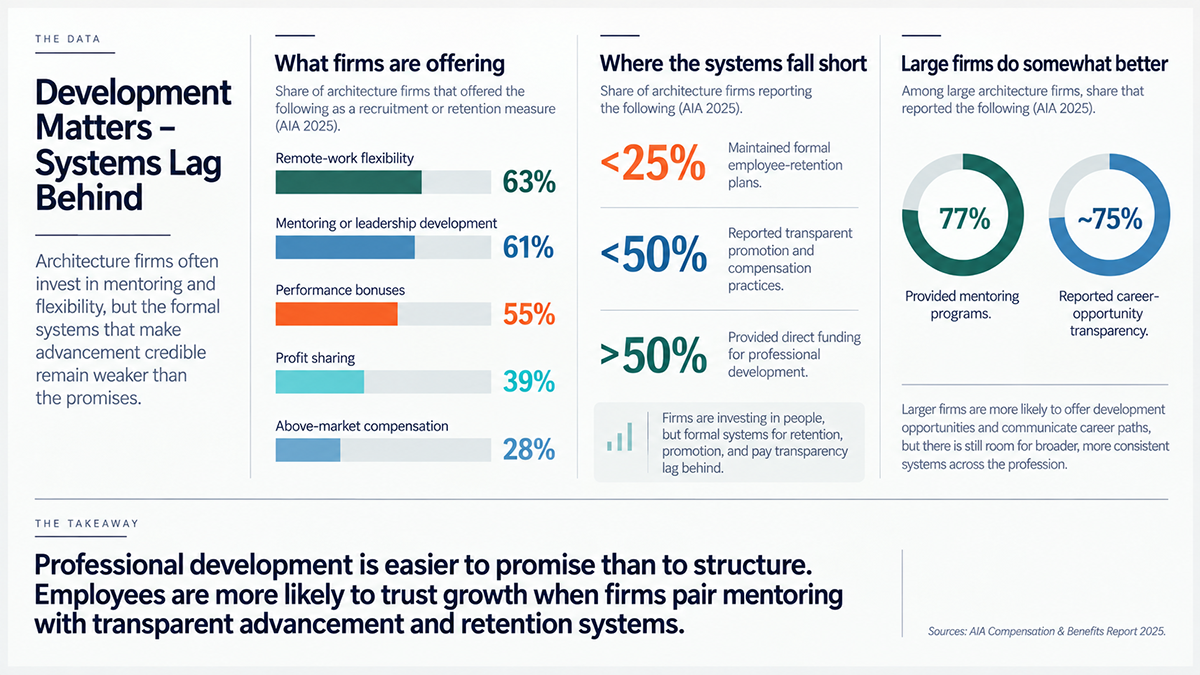
Professional growth then becomes a shared responsibility rather than something either side can deliver independently. The firm has to create real opportunities before it knows with certainty that the employee will succeed, which means accepting some inefficiency and occasionally giving responsibility to someone who is still learning how to carry it. The employee has to respond by taking ownership of those opportunities and demonstrating capability before every additional dollar or title has been guaranteed. That does not permit firms to leave someone operating indefinitely above their role while continuing to describe it as development, because the period of proving readiness has to lead somewhere if the arrangement is going to remain credible. Expectations should be clear enough that both sides can eventually recognize when the next level has been reached, and leadership should be willing to have the conversation when the employee believes they have crossed that threshold. Development works best when the employee knows what they are trying to prove and the firm knows what it has agreed to recognize once they do.
Recognition closes the loop because demonstrated growth eventually has to change something tangible about the relationship. Compensation is part of that, and firms that consistently trail the market cannot reasonably expect culture to compensate for the difference forever, although being competitive is not the same thing as winning every salary auction that happens to arrive in someone’s inbox. Greater responsibility should eventually lead to greater compensation, influence, or opportunity in a way that confirms the investment was real rather than ceremonial. Employees also have some responsibility to evaluate the entire value of what they are receiving rather than reducing every career decision to whichever number is currently largest, because a professional life accumulates through experience and access just as surely as it accumulates through salary. The healthier arrangement is one where the firm makes opportunity visible, the employee demonstrates what they can do with it, and the organization follows through when that growth becomes real. Loyalty costs something on both sides because each party has to invest before every outcome is certain, and perhaps the real failure of the old model was not that people stopped believing in loyalty, but that we stopped being clear about what each side was expected to contribute to earn it.
Ep 210: The Cost of Loyalty
Loyalty still has value, and I don’t think people have somehow become less capable of giving it than they were twenty years ago. What has changed is that fewer employees are willing to assume the relationship will eventually become reciprocal simply because they stay long enough, which means firms have to be more intentional about demonstrating why that investment makes sense. There is probably something healthy about that, even if it creates more work for those of us responsible for building and maintaining a firm culture, because the old system benefited from conditions we rarely had to examine and sometimes mistook for commitment. A culture built deliberately around trust, meaningful growth, and a visible connection between contribution and opportunity might actually be stronger than one that depended primarily on people staying in the same place for a very long time. The cost of loyalty has not become too high; we have simply reached a point where both sides are paying closer attention to what they are being asked to give, and firms that want lasting commitment must be willing to make their investment as visible as the one they expect from everyone else.
Cheers,

Special thanks to our sponsor, Construction Specialties, maker of architectural building products designed to master the movement of buildings, people, and natural elements. Construction Specialties has been creating inspired solutions for a more “intelligently built” environment since 1948. Visit MasteringMovement.net to learn more.