
So you are thinking about teaching architecture. You’ve got some years of experience under your belt and you want to share your knowledge with the next generation. Or you’ve always felt a calling to teach the next generation of the profession? Maybe you just want to try something different and it seems like an easy transition? Well today Bob and I are breaking this topic wide open and revealing some of the elements involved in going from working in a firm to teaching in academia. Welcome to episode 202: From Practice to Professor.
[Note: If you are reading this via email, click here to access the on-site audio player] Podcast: Embed Subscribe: Apple Podcasts | Spotify | Android | iHeartRadio | TuneIn

I want to set this post (and the episode) up with a few clarifying statements. First, this article is based on the premise of transitioning to academia full time. So, many of the elements in this discussion are based on that assumption. This concept represents a bigger change to your lifestyle and relationship to architecture than simply teaching as an adjunct or part-time instructor. So a majority of what is presented here is from that perspective. If you are interested in teaching part-time, while still firmly grounded in practice, that is another path and set of parameters as well. Maybe I will make an accompanying post on that idea in the near future. But for the sake of this post, it revolves around a change in careers, not just the addition of part-time teaching.
Second, this is all based on my experiences at my own institution along with discussion with colleagues from other universities across the country. I have had the opportunity now to meet many fellow professors at conferences and meetings and somehow this topic almost always comes up. Maybe because I like to discuss it, so I manage to work it into conversations. Now we can move on to five issues to consider as you contemplate this type of transition. This is by no means meant to encompass all the considerations of this transition, but highlight a few that have stood out to me over the last several years.
Academia Is a Fundamentally Different Professional Environment jump to 4:37
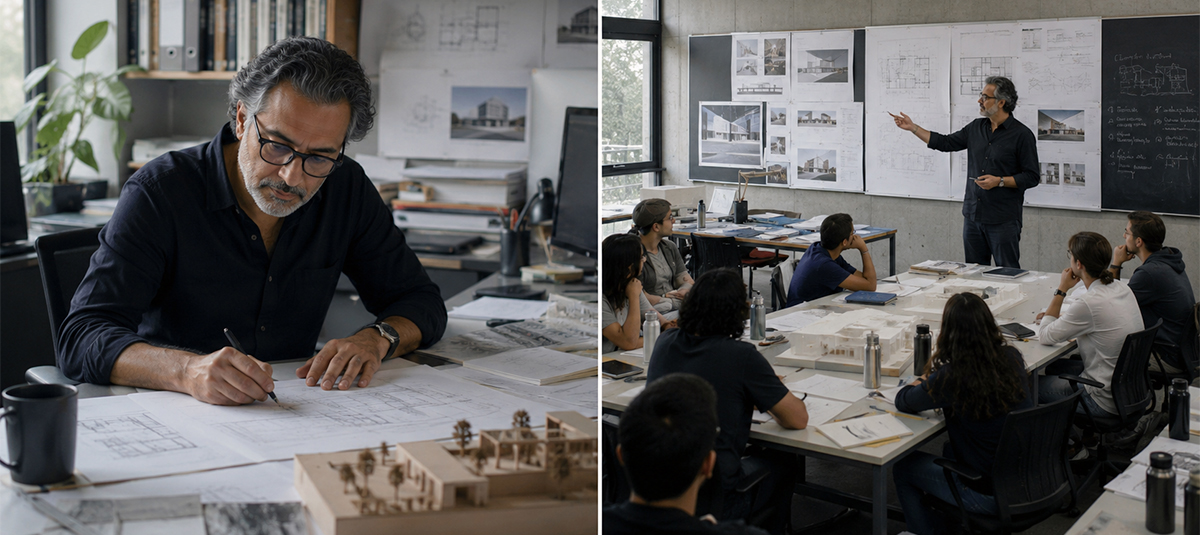
Teaching architecture is not simply an extension of practice. Nor does it operate like practice. They are two truly distinct worlds that simply share the common language of architecture in this case. To be blunt, most academic systems are not structured very well to even accommodate architectural education.
Many practicing architects assume academia is simply: “practice with students.” Teaching architecture is not simply practicing architecture in front of students. Because the day-to-day structure, incentives, pace, and goals are entirely different.
Practice revolves around clients, deadlines, budgets, liability, project delivery, efficiency, risk management, etc. These are all tangible elements of influence and feedback that work in most often direct and short cycles. It moves quicker and typically reacts faster to external conditions such as market trends and economic conditions. While it may not always feel it, the profession is faster paced.
Academia revolves around semesters, learnings, inquiry and curiosity, intellectual developments, institutional systems, intellectual work, student development, administrative structures, and long term goals and objectives. It typically moves slow and is bureaucracy heavy. It reacts slower to external forces and is not usually considered nimble by anyone.
This becomes quite clear with it relates to things like:
- work culture
- pace of life
- definitions of productivity
- definitions of success/failure
- forms of stress
- different types of responsibility
Academia and practice are fundamentally different systems with different goals, incentives, and definitions of success. In practice, almost every task has an immediate external consequence. In academia, many efforts have delayed or indirect outcomes.
Institutional Type Changes the Role jump to 14:18
This is maybe the one thing that most practitioners do not even comprehend or probably even consider when thinking about the transition into teaching. A practitioner may imagine “being a professor” as one thing, but institutions vary dramatically. Many practitioners enter academia without realizing that “being a professor” means radically different things depending on the institution. About 65% of the 143-44 institutions offering architecture degrees are R1/R2 classified by the Carnegie classification system. The next 28% are what would be considered ‘teaching/liberal arts” institutions that are not as intensely focused on research. The last 7% are hybrid or specialized schools. [Carnegie Classifications]
| R1/R2/RSU institutions: | Teaching-focused institutions: | Professional Programs or Hybrid types: |
| • Research-oriented | • Classroom-heavy | • balancing teaching and scholarship |
| • Publication-focused | • Student-centered | • maintaining practice credibility |
| • Theoretical engagement | • Pedagogically oriented | • contributing to accreditation and professional preparation |
| • Prestige through scholarship | • Student mentorship | • may value practice credibility more heavily |
| • Research output | • Curriculum development | • not many programs in this typology, very limited. |
| • Research grants | • Student advising | |
| • Scholarly visibility / notoriety | • Instructional effectiveness |
Architecture exists in an unusual position because professional legitimacy, scholarly legitimacy, and teaching legitimacy do not always align. These are also not always evenly weighted in academia. Again depending on the type of institution, one will always have more value than the others. Teaching is only one part of academic labor. Another surprise for many professionals is that there are also so many other “requirements” of your time. These include a wide array of “other work”:
- committee work
- accreditation
- assessment
- advising
- institutional politics
- service obligations
- research expectations
This is often shocking to architects entering academia from practice. Now of course this is speaking mostly to the idea of moving into teaching full time and not as an adjunct or part time faculty member. Those roles are definitely different. They share some of the same qualities, but not really all of the responsibilities of a full time position.
Many architects enter higher education initially through adjunct or part-time roles. These positions can be an easy opportunities to share professional knowledge and also test interest in teaching. This allows you to test the waters and not quit your day job. But adjunct teaching and full-time academic appointments are fundamentally different experiences.
| Full-time academic roles responsibilities: | Part-time roles responsibilities: |
| • research and scholarship | • Usually teaching a single studio or lecture course |
| • institutional service and committee work | • drawing upon current professional expertise |
| • advising and curriculum development | • maintaining connection to practice |
| • faculty governance and accreditation responsibilities |
This distinction matters because many of the challenges associated with academic transition are largely absent in adjunct teaching. An architect can successfully teach one studio while continuing professional practice and never encounter many of the structural realities of academic life. It can possible put a strain on the “professional” portion of the life, as I would also say that studio (or any teaching) puts more demands on your time than you might think.
There is also a larger trend occurring at the moment in most areas of higher education. The rise of contingent faculty. The pressures on higher education appear to be increasing reliance on contingent and part-time faculty appointments. This means more adjunct, part-time, or pro-tem positions may be available. While architecture programs have historically relied heavily on practicing architects as studio instructors, the impact is still credible. This mileage varies by institution of course. At the moment, according to the American Association of University professors, in an article in 2024, stated that more than 70% of all faculty are contingent or adjunct. This number may seem large, but it means only 30% of faculty are tenured or tenure-track. This has been a historic decline since the 1970’s. The article also goes on to discuss the gross underpayment of this contingent faculty group and how it is a major cost saving effort by most higher education institutions. That is an entirely different rabbit hole. [article A] [article B]
But this adjunct percentage does create some interesting concern and dilemmas for the institutions of higher education. Does teaching architecture part-time preserve stronger connections to practice, or does it gradually separate educational labor from the broader academic mission? Which is more important? I think each side has its own answer here, thusly creating the consistent divide between practice and academia.
| *Sidenote: to settle a ‘discussion’ from the podcast; Bob’s B-Arch degree required 187 credit hours to graduate in the early 1990’s. This is certainly a lot of hours, no doubting that. Yet, the current required hours for the B-Arch at the same university is 161 credit hours. So even time has made comparisons of degree values a complex mathematical task. Currently, most NAAB 5 year B-Arch degrees require 150-170 hours to earn a degree. |
Teaching and the Difficulty of Translating Experience jump to 30:13

At this point some practicing architects often realize a difficult reality. “I know how to create architecture as a professional, but explaining architecture systematically and in pieces is much harder.”
In practice often knowledge is progressively transferred, often by repetition, yet some is still intuitive. Also mentorship can happen more informally, yes also structured, but not in the same manner. Another element, and this is the kicker, lessons emerge naturally through project work and the process of daily, monthly, and yearly opportunities. There is a large amount of learning that is embedded in the workflow of any early career position. There are lessons and opportunities to learn that occur in many unplanned events or through “project-centered” opportunities. That is just the nature of work in an architecture office. Everyday there is an opportunity for new learning. This is true almost throughout your career in ANY office.
That is not an easy condition to replicate in an academic setting. Trust me. Any singular project in an office provides more opportunities for learning than any single semester of school every can. And that is a nature of the imbalance that will never be corrected. It can’t be. This may be the one single characteristic that most professionals cannot comprehend; and why there will always remain a divide between practice and academia.
In academia everything has to be fabricated and conceived. It must be manufactured for the course, studio, and student experience. Professional experience must be translated into structured learning as a process. Also as a set of frameworks that are repeatable by both the students and you as a professor. All of your tacit knowledge must become explicit. We have discussed this idea before, but that tacit, experiential knowledge is not easy to replicate or translate into something tangible for students. So creating authentic learning situations is surprisingly difficult because the realities of practice occur organically while education requires intentional construction.
Creating these frameworks is difficult. The more that I teach, the more apparent this has become for me. For several years, I attempted to cram professional conditions onto my studios without much success or without strong outcomes. It’s not that the students were not capable, but the idea that you can force them into professional situations by creating a framework is a tenuous concept. Now of course, I still run my studios and classes with the premise of professional practice, but the lessons, methods, and outcomes must be conceived of in a different manner than before. First, students are not employees. This creates a different mindset from the start. Second, the stakes are not as high in studio as in the office; and everyone involved knows it. You, the students, the guests, the administration, everyone knows. So these two factors make it difficult to simulate the realism of a professional office environment that also creates specific opportunities to learn. Additionally, there are important issues of abstraction, critical thinking, pedagogy and the like that are meant to help the students grow into professionals. These elements are not usually present in the training or onboarding in the professional office. Yet they are expected to be present upon entrance to the profession.
Architecture as Service vs Architecture as Inquiry jump to 41:19
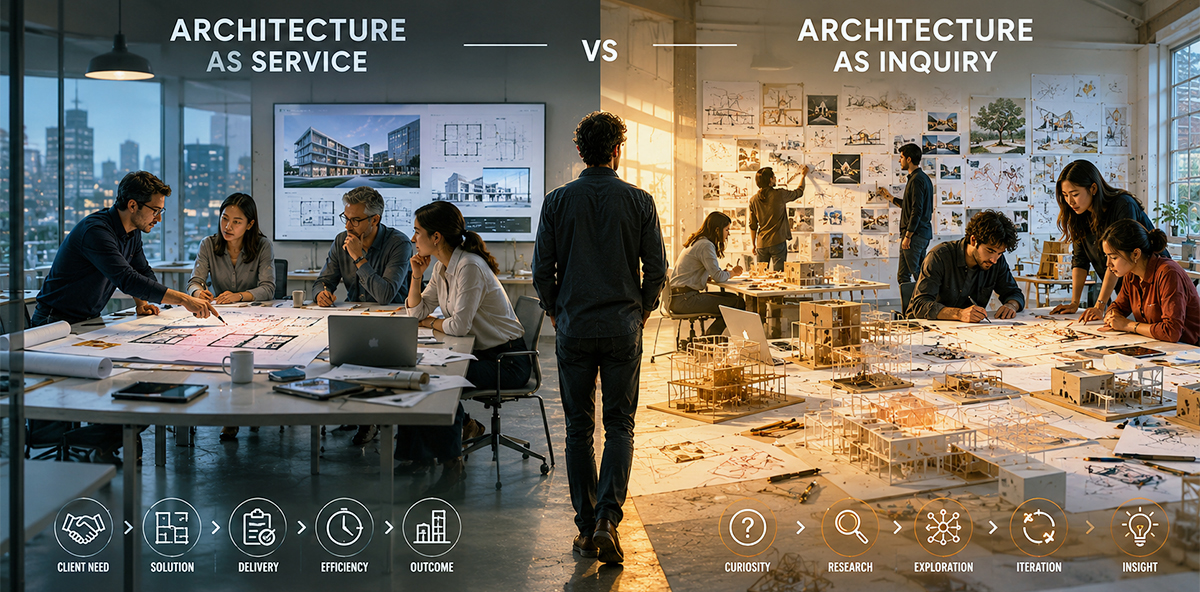
This is probably the most difficult topic to discuss and realize. It represents a major shift in your thinking as a professional. In some ways, it is contradictory to all that you have been exposed to or taught in the world of practice. Even though I am consistently reminding and reinforcing my students that architecture is a service profession, it is not the most beneficial approach to teaching; at least for design studios.
| Professional practice tends to prioritize: | Academic environments often prioritize: |
| • resolution | • abstraction |
| • efficiency | • questioning |
| • technical competence | • speculation |
| • delivery | • discourse |
| • decisiveness | • experimentation |
| • risk reduction | • boundary pushing |
| • regulatory adherence | • exploration |
Many practicing architects entering academia experience tension here because academia may, and usually does, intentionally resist immediate resolution. This can feel disconnected from the imperative of decision making in practice. This is a condition that I still struggle with even after eight years in academia on many levels. But not all of that relates to the act of teaching or being in the classroom. There are other issues where this ‘distaste’ for finite decision making rears its head in academia. This is, as you might expect, a double-edged sword that can work both for and against you.
Over time, you realize the university is one of the few places where architecture can still be examined critically without the immediate pressures of the market. This allows you to slow down some. As a firm owner of almost 20 years, that concept took some adjustment. As previously stated, I am still adjusting. But this shift to a slower consideration of architecture also allows you to use your previous knowledge and tempo from practice to inform your views on architecture as a practice and as a discipline. If you can settle into the reduced pace, you can find ways to more deeply explore your ideologies from practice and your place within architecture. This can be a wondrous occurrence. It can be a meaningful shift in your relationship to architecture.
The biggest truth of this concept is the distinction between architecture as professional service and architecture as disciplinary inquiry. This is probably one of the most important underlying tensions in architectural education and any transition from practice to professor.
The Personal Shift in Identity and Agency jump to 48:46

The transition changes how architects relate to their own work and influence. A practitioner entering academia eventually realizes that the transition is not simply operational or institutional. It is personal. It changes a great deal about how you view both the profession and academia.
In practice, architects directly shape projects with their work. Progress is visible and tangible, almost every day. Finally, the buildings become the output of the work and effort. They represent a physical indicator of time, effort, and knowledge. They can be experienced and examined for years to come. You can go see them and check up any time you please.
In academia, influence occurs through students and in much shorter frequencies. An educator’s impact may take years to become visible, if ever. Many students will never be seen again. The professor’s intellectual contribution can matter more than built work, but may also be difficult to see or experience. Not many people ever thank their teachers later in life. Think about it, I’m right. For a practicing architect who transitions to academia this creates two very different consequences; a loss of direct agency and the creation of broader long-term influence. At times, this is a difficult paring to resolve internally. This is one that comes down to personal disposition and feelings of success.
This has been a slow change and realization for me over the past five or so years of full time teaching. My own relationship to the practice and my views on how it should focus and function, or how I might re-integrate myself into it, has all been influenced by my time in academia. I found the one thing that most surprising is my longing to make buildings. By this I mean that I miss the process of having visions from my mind become manifested in the physical world. To have the ability to point at a physical building and say “I did that”, is something I miss much more than I ever anticipated. I mean, I did even consider it as a side effect of moving into academia. Yet the longer I am removed from that manifestation, the more I long for it. There are, of course, many other aspects of my attitude towards the profession that I love which have been altered due to my time in academia, but that is probably an entire other post.
I also have not yet embraced the notion that my legacy is now students whom I have taught. In practice, my legacy was the buildings and projects that I created. This, of course, disappears in academia. This is also a shift of relationship that I am still coming to grips with as an educator. Of course, when I was practicing, I took pride in mentoring employees, and am very proud of where many of them are today after leaving my office. But that process in academia feels very different. I do not truly have the same level of engagement with any student that I had with an employee. The time spent is much different and therefore, for me, it is more difficult to take ‘ownership’ over the student and their accomplishments. I do know of many colleagues who have this mentality of student legacy, so maybe it just takes longer to develop.
The transition from practice to academia is ultimately a shift from producing architecture directly to shaping the future people and ideas that will produce architecture later. That is a very different form of professional contribution.
Ep 202: From Practice to Professor
So when you begin thinking about a transition into teaching architecture, it may not be as straightforward as it first appears. While both practice and academia share a common disciplinary foundation, they operate according to very different assumptions, incentives, and measures of success. The transition is not simply a change in workplace. It is a change in professional culture, intellectual priorities, daily responsibilities, and ultimately personal identity.
For some architects, teaching becomes a natural extension of a desire to mentor others and contribute to the future of the profession. For others, it offers an opportunity to examine architecture from a different perspective, one less constrained by clients, schedules, budgets, and project delivery. Neither path is better than the other. They simply represent different ways of contributing to the discipline of architecture.
Maybe, the most important realization is that academia is not an escape from architecture. Also, it is not simply architecture practiced by different means. It is its own professional world with its own challenges, rewards, frustrations, and opportunities. An architect who moves into academia eventually discovers that the work is no longer primarily about producing buildings but is about producing knowledge, cultivating curiosity, developing future professionals, and participating in larger conversations about what architecture is and what it might become.
Eight years into this transition, I am still learning how to navigate the space between practice and academia. What I have discovered is that both worlds need one another far more than either is usually willing to admit.
Good luck,

Special thanks to our sponsor Construction Specialties, maker of architectural building products designed to master the movement of buildings, people, and natural elements. Construction Specialties has been creating inspired solutions for a more “intelligently built” environment since 1948. Visit MasteringMovement.net to learn more.